
Rome Travel Guide
Rome is the only city on this list where half the major sights have been in the same place for 2,000 years, which changes how you plan around them. The Forum is on the same stones a Roman senator walked. The Pantheon's dome is the one Hadrian commissioned in 126 AD. The cacio e pepe at the Trastevere trattoria isn't a recipe so much as the dish that's been served at the same address since 1930. You don't visit Rome the way you visit a city — you walk through the layers and pay attention to what's underneath. The shortlist below is what survived repeat long weekends. The logistics layer at the back is the part Rome doesn't make easy: which Colosseum tickets to actually buy, the Borghese Gallery's strictly-enforced 2-hour windows, why dinner doesn't start before 20:00, and the cold-truth geography of pickpockets on the 64 bus.
VoyRay Trip Planner
Turn this guide into a real trip
Start an editable trip for Rome and use this guide as inspiration while choosing places and shaping each day.
12 places
The 72 AD amphitheater — 50,000 seats, 83-year gladiatorial history, still the largest standing amphitheater in the world. **Book timed-entry tickets online at coopculture.it 30+ days ahead** — walk-up queues are 90+ min in peak season. The combined ticket (18€) includes Roman Forum and Palatine Hill, valid 24 hours. **Skip the Rick Steves tour, pay for the official Underground & Arena Floor tour** (25€ upgrade) — you walk the actual gladiator passages and stand on the arena floor itself, a genuinely different experience from the standard ticket. The **Arena Floor access is key** — the view from the arena level is what the photos don't show.

The 2,000-year-old civic center where the Roman Empire was actually run. Shared ticket with the Colosseum. Priority route for 2 hours: enter at the Arch of Titus end (less crowded), walk west past the Temple of Saturn ruins, the Basilica of Maxentius and Constantine (the three brick arches that inspired the original St. Peter's dome), and the Curia Julia (the senate house where Caesar was assassinated — the actual building, still standing). **The forum is stronger at 08:00-09:00 before the heat** — midsummer afternoons are brutal.

The best-preserved ancient Roman building in the world — built 118-125 AD, converted to a church in 609, still in continuous use. The 43m unreinforced concrete dome is the largest ever built before the 20th century, and the 8.3m oculus at the top is still open to the sky (rain falls through; the floor drains it). **Free entry on Sundays, 5€ weekdays** (new 2023 fee). Raphael is buried on the interior left wall. Go at 09:00 opening for the empty version or late afternoon for the north-lit dome. The Piazza della Rotonda out front is a proper evening apéritif stop.

The world's richest art collection housed in the palaces of the Popes — 7km of galleries, 12 million visitors a year, and the Sistine Chapel ceiling at the end. **Book online at museivaticani.va** (25€ basic, 32€ with an audio guide) 30+ days ahead; walk-up queues run 2-3 hours. **Friday evening slots (19:00-21:00) are the secret** — two-thirds the crowd, the Pauline Chapel often open. Priority galleries: Pio-Clementino (Laocoön, Apollo Belvedere), the Raphael Rooms, and the Sistine Chapel. Expect 3-4 hours minimum; dress code enforced (no shorts above the knee, shoulders covered).
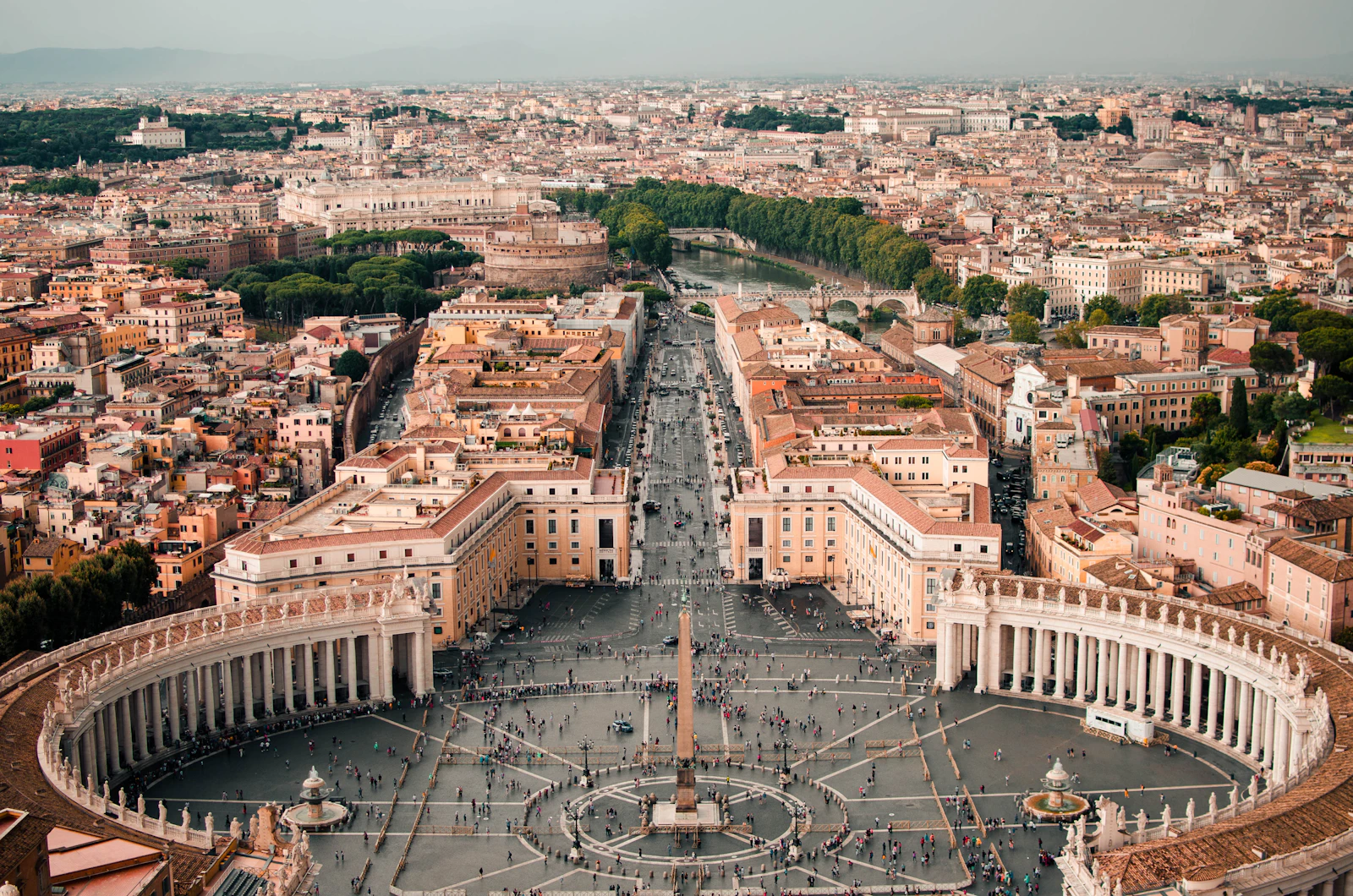
The 16th-century papal basilica — 190m long, seats 60,000, the largest church in the world. **Free entry, no ticket needed** (but security queue is 30-60 min in high season; arrive at 07:00 opening or after 16:00 for a shorter wait). **Climb the dome** (10€ elevator + 320 stairs, or 8€ all-stairs) for the best roof view of Rome and of the papal garden. Bernini's baldacchino over the main altar is the world's largest bronze sculpture; the Pietà in the right chapel is behind bulletproof glass after a 1972 hammer attack. Papal audiences Wednesdays at 09:30 are free with advance ticket.

Nicola Salvi's 1762 masterpiece — the Baroque fountain at the intersection of three roads (tre vie = Trevi). **Go at 06:30 before the crowds** for the version with no selfie sticks; the fountain is spotlit until 02:00 so late-night is the other good window. Throwing a coin with your right hand over your left shoulder means you'll return to Rome (approximately 3,000€ a day is collected and donated to Caritas). Restaurants on the adjacent streets are all tourist traps; walk 3 blocks in any direction for actual food.

The most photogenic square in Rome — built over Domitian's 1st-century chariot stadium (the elongated shape is still the stadium footprint). Three fountains: Bernini's Fountain of the Four Rivers in the center (1651, the figures represent the Nile, Ganges, Danube, and Río de la Plata), Fontana del Moro at the south, and Fontana del Nettuno at the north. The baroque Sant'Agnese in Agone church is worth stepping inside. Evenings the piazza fills with street performers and caricaturists — pleasant without being oppressive like Trevi.
_-_BEIC_6329173.jpg)
The 138-step 18th-century staircase connecting Piazza di Spagna to the Trinità dei Monti church above. **Sitting on the steps is now technically fineable** (250€, enforced by the municipal police, real crackdown since 2019). Go early morning for the photograph; the Keats-Shelley House at the base (where Keats died in 1821) is a worthwhile 45-minute museum stop. At the top of the steps, turn right for a half-block to Via Sistina for the best backstreet walk back toward the Trevi Fountain area.

Cardinal Scipione Borghese's 17th-century art collection — 22 Bernini sculptures (including the Rape of Proserpina and Apollo and Daphne, both gut-punches), six Caravaggios, Titian's Sacred and Profane Love. **Timed-entry ticket system** (25€, 2-hour windows, strictly enforced) — book online at tosc.it or through the official Galleria Borghese site 2-3 weeks ahead; walk-up is effectively impossible. The sculpture-heavy Ground Floor first, then Paintings upstairs. **Closed Mondays**.

Hadrian's 139 AD mausoleum, converted to a papal fortress in the 14th century, connected to the Vatican by a raised passageway (the passetto — a 800m papal escape route, used by Clement VII in the 1527 sack of Rome). Ticket 17€. The spiral ramp up to the papal apartments is a uniquely satisfying architectural experience (no stairs, just one continuous incline). **The Angel Terrace on top** has the best Vatican + Tiber panoramic view in Rome — Bernini's angel statues on the Ponte Sant'Angelo approach are an essential pre-visit walk.
.jpg)
The medieval Trastevere quarter west of the Tiber — narrow cobblestoned streets, ivy-covered walls, 17th-century trattorias still in family hands, the most reliable dinner neighborhood in central Rome. The two squares worth orienting by: **Piazza Santa Maria in Trastevere** (with the 12th-century basilica, 20:00-22:00 is the people-watching hour) and **Piazza di San Cosimato** (local-neighborhood, Sunday market in the morning). Day-crowded, night-busy but never oppressive. 90 min is enough for a walkthrough; 3 hours for a proper dinner-and-drift.
The legendary founding site of Rome — where Romulus supposedly killed Remus in 753 BC, and where later the imperial palaces of Augustus, Tiberius, and Domitian were built. Shared ticket with the Colosseum and Forum. Priority route: the House of Augustus (recently restored frescoes, specific 30-min timed entry slots), the Palatine Museum's 1st-century sculpture fragments, and the viewpoint over the Circus Maximus to the south. **The Palatine is the part of the Colosseum combined ticket that most visitors skip** — which is why the hill at 11:00 is actually quiet. 90 min is the right dwell.

6 places
The tiny 14-seat Trastevere trattoria that sets the benchmark for Roman cacio e pepe. Via dei Vascellari 29. No reservations for dinner; queue starts forming at 18:45 for the 19:00 opening and the wait runs 60-90 min on weekends. **Order**: cacio e pepe (the dish here — rigatoni, Pecorino Romano, black pepper, nothing else), fiori di zucca (zucchini blossoms stuffed with anchovy and mozzarella, deep-fried), and the artichoke alla giudia in season (winter through spring). 35-45€/head with a quartino of house red. Cash only historically; cards now accepted.
The 1938 Roman fish restaurant in Piazza de' Ricci — a 5-min walk from Campo de' Fiori. The fish is flown in daily from the Lazio coast; they'll show you the catch display before ordering. **Must-order**: the signature spaghetti alle vongole (Venus clams, Sardinian bottarga grated over the top, the best version in the city), the grilled orata (sea bream) for two, and whatever burrata is on that day. 80-100€/head with wine. **Book 2-3 weeks ahead**; outside Campo de' Fiori's square so you avoid the tourist crush.
The 1936 Testaccio trattoria that's continuously served the same Roman menu to the neighborhood's slaughterhouse workers and now to the rest of the city. **Order the tonnarelli cacio e pepe** — they still mix it tableside in front of you, the most theatrical version of this dish in Rome. Also: coda alla vaccinara (oxtail stewed 5 hours in tomato and celery, a Testaccio signature), saltimbocca, and artichokes in season. 45-60€/head. Reservations essential (online via their site 2-3 weeks ahead); they enforce 19:30 and 21:00 seatings strictly.
A 1972 deli-bakery-wine-bar trifecta on Via dei Giubbonari. The Salumeria (the original shop) does the city's best cheese and cured-meat selections; the adjacent Pastificio is a takeaway pasta counter; the restaurant upstairs is where the wine list opens up (700+ labels, the best Italian wine selection in Rome). **Lunch pick: the salumi board** (30€) paired with their 1958-recipe burrata and a glass of Fiano di Avellino. **Book ahead for dinner**; walk-up at 12:00 lunch usually works.
Gabriele Bonci's pizza-al-taglio institution across the street from the Vatican's Cipro metro. The pies are sourdough-leavened 72 hours, topped seasonally (there are usually 20+ varieties changing daily — pistachio-burrata-mortadella is the signature; potato-rosemary is the tradition), cut to weight at the counter. 5€ buys you a substantial slice; 12€ gets you three varieties + a beer. **Takeaway only — no seating**; eat on the Via della Meloria curb or walk 3 blocks south to the Vatican walls. Closed Sundays.
The 1890 Giolitti original — the Pantheon-area gelato shop that inspired every other Rome gelateria. 40+ flavors daily, still using the same recipes. **Order the zabaione** (Marsala-cream base, the house signature) or the **riso** (rice-based, an 1890 survival, honestly excellent). Medium cup is 4.50€ and comes with whipped cream on top automatically. Peak-evening queues run 20-30 min; morning is calmer. The shop interior is a preserved 19th-century coffee-house setup worth stepping inside even without ordering.

5 places
Piazza del Popolo's 1816 Rocco Forte-restored hotel — once Stravinsky's, Cocteau's, and Picasso's Rome base. 120 rooms, terraced garden that climbs the Pincio Hill behind, Stravinsky Bar in the garden that's one of the city's best quiet cocktail rooms. Rates from 1,200€/night in low season. Location is the single best in Rome for a first visit — 5 min to the Spanish Steps, 10 min to Villa Borghese, 15 min to Piazza Navona, all on foot.

At the top of the Spanish Steps — the 1893 hotel that still sets the ceiling for old-school Rome luxury. 92 rooms and suites, hand-painted frescoes in the Piazza Navona Suite, the Imàgo rooftop restaurant with a 180° view across central Rome. Rates from 1,100€/night in low season. Service is the classically old-school kind — jackets at breakfast, a pianist in the lobby at 18:00 nightly. The rooftop at sunset is the single best skyline view of any Rome hotel.

The 30-room boutique in Via di Monte d'Oro, in the centro storico between the Pantheon and Piazza del Popolo. Michele Bönan interiors — the kind of muted Italian-hotel aesthetic (warm wood, travertine bathrooms, vintage Italian art) that other Italian boutiques now imitate. 800-1,400€/night. The ground-floor restaurant (JK Cafe) is open to the public and is a proper lunch reservation-or-walk-in spot.
The 2023 Hoxton opening in the Salario district — a 15-min walk from Piazza del Popolo and Villa Borghese. 192 rooms across a 1960s Italian-modernist building. The lobby + 24-hour Cambio Vista cafe is the neighborhood's best workplace-not-office option. Rates from 280-450€/night. Location is slightly off-centro (requires 15 min walk or a 5 min taxi to the main sights), but the hotel's specific design quality makes it the right mid-luxury pick for travelers who want a room that isn't a classic Rome pastel.
The 2023 CitizenM on Via del Campidoglio, at the edge of the Jewish Ghetto and Tiber Island — a 10-min walk to the Colosseum, 5 min to Trastevere across the Ponte Fabricio. Standard CitizenM capsule rooms (15m², king bed wall-to-wall, iPad controls everything). 200-350€/night — the best 'design-forward budget' option in central Rome. Location is genuinely excellent for a first-timer visit; food and drink on the ground floor is open 24 hours.