
Vienna 3-Day Museum + Imperial + Prater
Vienna 3-Day Museum + Imperial + Prater
Three days of Vienna is enough to understand the city's central intellectual proposition: that the collapse of the Habsburg Empire in 1918 produced a cultural flowering — Freud, Klimt, Schiele, Wittgenstein, Mahler, Schoenberg — precisely because the institution sustaining the city for six centuries was visibly ending. The MuseumsQuartier's Leopold Museum holds the world's largest Schiele collection in the former imperial stables; the Secession building a 10-minute walk south holds Klimt's Beethoven Frieze in the basement, painted in 1902 for an exhibition never meant to be permanent. The Naschmarkt's 120 stalls run along the covered-over River Wien, which was buried underground in 1900.
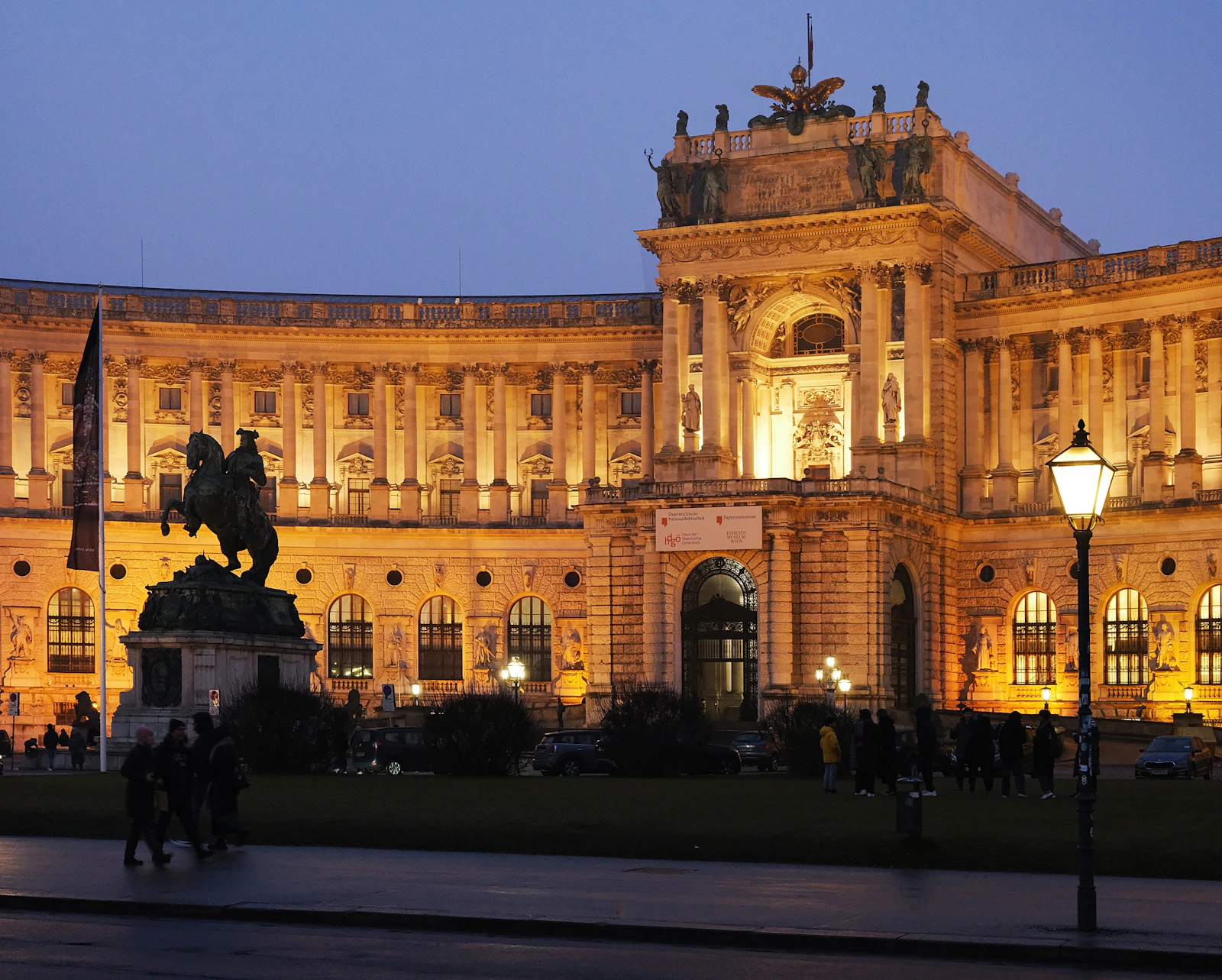
The second day covers the Habsburg operational core: the Spanish Riding School's morning training in the 1735 Winter Riding Hall, the National Library's 200,000-volume Prunksaal, and the Staatsoper at night — where standing-room tickets are €15 and the view from the Stehplatz fourth row is better than most seated positions. The third day leaves the Ring for the Prater and the 3rd district: the 1897 Riesenrad still turning above the amusement park, Schweizerhaus's pork knuckle under the horse-chestnut trees, and Hundertwasser's undulating residential facade from 1985.
VoyRay Trip Planner
Make this itinerary your own
Start a new editable trip for Vienna, then adjust the dates, route, places, budget, and travel pace to fit you.
Contents
Day 1
Day 1 — MuseumsQuartier + Steirereck
The former imperial stables of the Hofburg were converted into the MuseumsQuartier in 2001, which is the kind of reuse Vienna produces without apparent irony. The Leopold Museum holds the world's largest Schiele collection; the Kunsthistorisches Museum eight minutes north holds twelve Bruegel the Elder paintings in a single room — more than any other museum. The Naschmarkt's counter stalls at midday are the city's working eating-place; the Secession building's Beethoven Frieze in the basement is the 34-meter gilded mural Klimt painted for a single 1902 exhibition and which has been in the basement ever since. Steirereck's glass pavilion in the Stadtpark closes the day at the appropriate altitude.

Once the imperial stables, the MQ is now one of the world's largest districts for contemporary art and culture. It is a unique blend of Baroque buildings and modern architecture, centering around a massive interior courtyard. The vibe is laid-back and youthful, with the famous 'Enzi' lounge furniture providing a place for locals to socialize. Expert recommendation: Visit during the summer evenings when the courtyard becomes a vibrant outdoor lounge with DJ sets and pop-up bars. Practical pro tip: Use the MQ as your base for a 'museum day,' as the Leopold, Mumok, and Kunsthalle are all within 100 meters of each other. Most cafes here offer excellent brunch options.

The Leopold Museum is the most visited museum in the MuseumsQuartier, housing the world's largest Egon Schiele collection and masterpieces by Gustav Klimt. The building itself is a white limestone cube that floods the interior with natural light, creating a stark, modern backdrop for the intense Expressionist works within. The sensory experience is often provocative, reflecting the radical spirit of 'Vienna 1900.' Expert recommendation: Check out the top floor for the 'Vienna 1900' permanent exhibit, which provides the best context for the city's artistic explosion. Practical pro tip: The museum shop is excellent for high-quality art prints and unique Viennese design gifts. It stays open until 9 pm on Thursdays.

Commissioned by Emperor Franz Joseph I to house the Habsburgs' formidable art collection, this museum is as much a work of art as the treasures it contains. The interior features a grand staircase with ceiling paintings by Gustav Klimt and colleagues. Its galleries hold world-class works by Bruegel, Vermeer, and Rubens. The atmosphere is one of hushed, palatial grandeur. Expert recommendation: The 'Kunstkammer' (Chamber of Art and Wonders) features the famous Saliera by Benvenuto Cellini. Practical pro tip: The museum cafe, located in the stunning cupola hall, is widely considered one of the most beautiful in the world—perfect for a mid-gallery break. Thursdays often feature late-night openings with dinner options.
Vienna's most popular food market has existed since the 16th century, now stretching for over 1.5 kilometers. It is a vibrant sensory explosion of smells—from Austrian cheeses to exotic Middle Eastern spices—and colorful displays of fresh produce and seafood. The market bridges the gap between old-world tradition and trendy gastronomy. Expert recommendation: Try the 'Käsekrainer' (cheese-filled sausage) at a local stand or enjoy shakshuka at one of the Israeli bistros like NENI. Practical pro tip: On Saturdays, a massive flea market (Flohmarkt) adjoins the food stalls. It’s incredibly crowded but perfect for treasure hunters; arrive at sunrise for the best finds.

Built in 1897 as the exhibition hall for the Secessionist art movement, this building is a manifesto of 'Jugendstil' (Art Nouveau). Its iconic golden dome of laurel leaves is affectionately called 'the golden cabbage' by locals. The motto above the entrance, 'To every age its art, to every art its freedom,' still guides its mission. Expert recommendation: The basement houses Gustav Klimt's 'Beethoven Frieze,' a monumental 34-meter long cycle of paintings that is a cornerstone of Viennese Modernism. Practical pro tip: The main hall features rotating contemporary exhibitions that can be quite avant-garde. If you are only there for the Klimt, check the website to ensure that section is open during your visit.

Consistently ranked among the world's best restaurants, Steirereck is a futuristic glass-clad monolith in the heart of Stadtpark. Chef Heinz Reitbauer focuses on forgotten Austrian ingredients and rare citrus, presenting them with avant-garde techniques. The sensory experience is unparalleled, featuring a famous bread trolley with over 25 varieties and a cheese cellar that is a temple to dairy. Expert recommendation: The 'Char with Beeswax' is their signature dish, cooked table-side in molten wax. Practical pro tip: Book at least 2-3 months in advance for dinner. If you can't get a table, their sister bistro 'Meierei' next door offers a more accessible but equally refined experience of Austrian dairy and pastries.
Day 2
Day 2 — Spanish Riding School + Meissl & Schadn
The Spanish Riding School's Morning Exercise is not a performance — it's a training session in the 1735 Winter Riding Hall where the trainers correct, reset, and repeat the classical dressage forms without gala lighting. The National Library's Prunksaal is the 1735 Baroque hall where 200,000 Habsburg volumes sit on oak shelves under Daniel Gran's ceiling fresco of Charles VI's apotheosis. Peterskirche's gilded oval interior, Demel's Annatorte under the mirrored ceiling, and the Staatsoper's standing-room at 15€ follow in sequence. Meissl & Schadn stays open until 23:00 — the rare Viennese kitchen that answers the post-opera hunger.

This 450-year-old institution preserves the classical art of Haute Ecole horsemanship in the Baroque setting of the Winter Riding School. The famous Lipizzaner stallions perform intricate 'dances' that were originally military maneuvers. The experience is one of regal elegance, characterized by the white uniforms of the riders and the synchronized movements of the horses. Expert recommendation: If full performance tickets are too expensive, attend the 'Morning Exercise' (Morgenarbeit) to see the training process with musical accompaniment. Practical pro tip: Photography and video are strictly prohibited during all performances and training sessions. Book months ahead for gala performances as they sell out globally.

Located within the Hofburg complex, the State Hall (Prunksaal) of the National Library is widely considered one of the most beautiful historic library halls in the world. Built in the 18th century, it houses over 200,000 volumes including the collection of Prince Eugene of Savoy. The scent of old parchment and the sight of towering walnut bookcases under a frescoed dome create an awe-inspiring atmosphere. Expert recommendation: Look for the Venetian globes—one terrestrial and one celestial—each over a meter in diameter. Practical pro tip: Flash photography is strictly forbidden to protect the ancient books. It is often very quiet, making it a perfect contemplative escape from the busy city center.
.JPG?width=1280)
Inspired by St. Peter's Basilica in Rome, this Baroque church is hidden away in a small square just off the Graben. Completed in 1733, it features one of the most lavishly decorated interiors in Vienna, packed with gold leaf, intricate frescoes, and a massive green dome. The atmosphere is intimate yet overwhelming in its artistic density. Expert recommendation: The church is famous for its daily free organ recitals (usually around 3:00 PM) which make full use of the incredible acoustics. Practical pro tip: It can be very dark inside; visit on a sunny day when the light from the dome windows illuminates the altar. Entrance is free, but donations are encouraged for the upkeep of the music program.
Known as the 'Golden Quarter,' Kohlmarkt is the most expensive and prestigious shopping street in Vienna. Historically the market for charcoal (Kohle), it now hosts flagship stores for brands like Chanel, Gucci, and Cartier. The street offers a direct view of the Hofburg’s Michaelertor, creating a grand architectural backdrop for luxury browsing. Expert recommendation: Visit the legendary Demel pastry shop located right on the street to see their window displays of sugar art. Practical pro tip: Even if you aren't shopping for luxury goods, the street is worth a walk for the window displays and the view toward the palace. It is particularly magical during the Christmas season when it is draped in 'cascading' light displays.
Formerly the 'Purveyor to the Imperial and Royal Court,' Demel is a temple of sugar and chocolate. The interior is a masterpiece of dark wood and glass cases filled with intricate pastries. A unique feature is the glass-walled kitchen where you can watch the pastry chefs hand-pull strudel dough. The staff traditionally speaks in the third person, a relic of courtly etiquette. Expert recommendation: Their 'Kaiserschmarrn' (shredded pancakes) is widely considered the best in the city. Practical pro tip: Don't wait in the long sit-down line if you're in a hurry; the front counter offers 'to-go' versions of their most famous treats, including the Kaiserschmarrn in a box, which you can enjoy while walking to the Hofburg.

Opened in 1869 with Mozart’s 'Don Giovanni,' this Neo-Renaissance building is the epicenter of the music world. The interior is breathtaking, featuring a grand staircase, marble statues, and a gold-and-red auditorium known for its perfect acoustics. The atmosphere during a performance is electric, with a tradition of excellence that dates back to Mahler and Strauss. Expert recommendation: Take a guided tour to see the backstage areas and the opulent Tea Salon, normally closed to the public. Practical pro tip: If you're on a budget, standing room tickets are sold at a very low price 80 minutes before each performance—arrive early to join the queue behind the building.
This restaurant celebrates the 'Grand Hotel' era of Viennese cuisine, specifically reviving the tradition of the open Schnitzel kitchen. You can watch the chefs flour, egg, and bread the veal through a large window on the street. The interior is elegant, with leather banquettes and classic brass fixtures. Expert recommendation: This is the place to customize your Wiener Schnitzel—you can choose whether it's fried in lard, butter, or vegetable oil. Practical pro tip: They are also famous for their 'Garniertes Rindfleisch' (garnished beef), but the Schnitzel is the star. It's located right on the Ringstraße, making it an easy and high-quality dinner stop after an opera performance at the nearby Staatsoper.
Day 3
Day 3 — The Prater + Kunst Haus Wien
The Prater outside the Ring is a different Vienna — the 1766 public park Joseph II opened to the commoners, the 1897 Riesenrad still rotating above it, Schweizerhaus's beer garden under the horse-chestnut trees where the pork knuckle arrives at 1.2 kg and the Czech Budweiser is the correct order. Hundertwasserhaus in the 3rd district is the 1985 municipal housing project where undulating floors, grass roofs, and ceramic-tile facades were applied to ordinary apartments as a protest against straight lines. The Kunst Haus Wien next door is where the ecological-architecture drawings explain the philosophy the building demonstrates.

The Prater is a vast public park that was once a royal hunting ground, gifted to the people by Joseph II in 1766. It is divided into the 'Wurstelprater' (amusement park) and the 'Green Prater' (forests and meadows). The sensory experience ranges from the nostalgic clatter of old wooden rides to the serene rustle of chestnut trees along the Hauptallee. Expert recommendation: Take a walk down the 4.5km-long Hauptallee for a true local experience of jogging or cycling. Practical pro tip: Entry to the park is free; you only pay for individual rides. It’s most atmospheric at sunset when the neon lights of the fairground start to glow against the darkening sky.

An enduring symbol of the city since 1897, this giant Ferris wheel gained international fame after its appearance in the classic film 'The Third Man.' The wooden red gondolas offer a slow, majestic ascent to 65 meters, providing a vintage perspective of Vienna. The experience is one of nostalgic romance, particularly as the wheel creaks gently in the wind. Expert recommendation: The 'Panorama' museum at the entrance uses miniature theater boxes to tell the history of the Prater and the wheel. Practical pro tip: For a special occasion, you can book a private candle-lit dinner in one of the luxury cabins. Go during the 'blue hour' for the best lighting for photography.
Schweizerhaus is more than a restaurant; it’s a Viennese cultural phenomenon located in the Prater amusement park. It features one of the city's largest and most famous beer gardens. The atmosphere is loud, joyful, and quintessentially summer in Vienna. They are famous for Budweiser beer and their massive pork knuckles. Expert recommendation: The 'Stelze' (roasted pork knuckle) is a must—the skin is incredibly crispy. It is usually sold by weight, so specify if you want a smaller one. Practical pro tip: Note that Schweizerhaus is only open from March 15th to October 31st. It’s almost always crowded, but the turn-over is fast. Cash is king here, so bring enough for your Stelze and several rounds of beer.
.JPG?width=1280)
Designed by the eccentric artist Friedensreich Hundertwasser, this apartment house is a riot of color, uneven floors, and spontaneous vegetation. Completed in 1985, it challenges traditional architectural norms with its 'tree tenants' and lack of straight lines. The atmosphere is whimsical and organic, looking more like a fairytale illustration than a residence. Expert recommendation: Walk across to the 'Hundertwasser Village' nearby, a shopping mall designed in the same style where you can actually experience the uneven floors and unique bathroom designs. Practical pro tip: Remember that this is a private residential building; visitors are not allowed inside the apartments themselves. Respect the residents' privacy while taking photos of the spectacular facade.
Located just a few blocks from the Hundertwasserhaus, this museum was also designed by Friedensreich Hundertwasser and serves as a permanent exhibition of his philosophy and artworks. The building features his signature checkerboard facade, colorful mosaics, and lush roof gardens. Inside, you’ll find a comprehensive collection of his paintings, architectural models, and environmental manifestos. Expert recommendation: The museum also hosts world-class temporary photography exhibitions, so check their schedule before visiting. Practical pro tip: The museum's ground-floor bistro, 'Tian on the Go,' offers fantastic vegetarian and vegan options in a uniquely decorated setting. Wear comfortable shoes, as the floors inside are deliberately undulating.