
Rome 3-Day Classic
Rome 3-Day Classic
Rome has exactly three visible layers and the three-day format respects all of them without turning it into a forced march. The ancient layer is the one tourists arrive expecting; the papal-baroque layer is the one that keeps surprising them; the neighborhood layer — the Borghese's pine-shaded park, the wine bars off Piazza Navona — is the one that makes people extend their stay.
The first day goes to the Vatican compound and its surroundings: four hours in the museum complex with a Pizzarium lunch to recover, St. Peter's, Castel Sant'Angelo, and a Michelin dinner in the shadow of it all. The second day reverses the standard tourist sequence — starting at the Borghese Gallery's Bernini room before the mandatory 2-hour window closes, walking south to Piazza del Popolo, and ending at the Pantheon with a wine-bar dinner one block off Piazza Navona. The third day handles the ancient core at depth: the Colosseum at 08:30, Trajan's 2,000-year-old shopping mall, and the church that is three churches buried inside each other.
VoyRay Trip Planner
Make this itinerary your own
Start a new editable trip for Rome, then adjust the dates, route, places, budget, and travel pace to fit you.
Contents
Day 1
Day 1 — Vatican + Ponte Sant'Angelo
Bonci Pizzarium exists to protect visitors from the tourist-trap restaurants around the Vatican's exit. Four hours in the museum complex, then a counter lunch at Cipro before St. Peter's security queue clears at midday. Castel Sant'Angelo's spiral ramp leads to a terrace with a view north over the river that hasn't changed much since Hadrian's engineers built it. Il Pagliaccio for dinner: two Michelin stars near Piazza del Biscione.
The world's greatest collection of art accumulated over five centuries of papal patronage fills 54 galleries in the Vatican Palace, culminating in Michelangelo's Sistine Chapel ceiling painted between 1508-1512 while lying on scaffolding 20 meters above the floor—a physical and artistic feat that produced the most influential paintings in Western art history, including the iconic Creation of Adam. The Museum's Gallery of Maps with its stunning 16th-century cartographic frescoes, the Rafael Rooms with the School of Athens, the ancient Greek and Roman sculptures of the Laocoön group and the Apollo Belvedere, and the modern art collection added by recent popes create a day-long journey through the entirety of Western artistic tradition. Pre-booked tickets with early morning access significantly reduce the overwhelming crowds.
Gabriele Bonci's Pizzarium is often cited as the best 'pizza al taglio' (by the slice) in Italy. Using stone-ground flour and long fermentation, the crust is uniquely light yet crunchy. The toppings are the result of obsessive sourcing—think truffles, rare cheeses, and artisanal cured meats. The shop is tiny, so the 'dining room' is the sidewalk outside. Expert recommendation: the potato and mozzarella pizza sounds simple but is a masterclass in texture. Pro tip: it is located right next to the Cipro Metro station. Use the automated ticket machine for your turn and be prepared to wait; use the time to browse the incredible selection of craft beers available inside the shop.

As the spiritual center of the Catholic world, this Renaissance masterpiece features contributions from Bramante, Michelangelo, and Bernini. Standing on the site of St. Peter's burial, the basilica's interior is overwhelmingly vast, housing Michelangelo’s poignant 'Pietà' and Bernini’s bronze Baldacchino. The sensory experience is profound, from the smell of incense to the golden light filtering through the dome. Expert recommendation: climb the 551 steps to the Cupola (dome) for the most iconic bird's-eye view of St. Peter's Square. Pro tip: strict dress codes apply (no bare shoulders or knees); arrive before 7:30 AM to clear security before the lines extend several hours long.
.jpg)
Originally built as a mausoleum for Emperor Hadrian, this cylindrical fortress later served as a papal residence and prison, connected to the Vatican by the Passetto di Borgo secret passage. The structure offers a layered history of Rome, from ancient tombs to Renaissance apartments decorated with lavish frescoes. The terrace under the bronze angel statue provides one of the city's best 360-degree views, especially overlooking the Tiber. Expert recommendation: look for the weapon collections and the historical prison cells. Pro tip: visit during the 'blue hour' just after sunset to see the bridge's angel statues glowing against the darkening sky; the rooftop cafe is surprisingly good for a scenic rest.

Originally built by Hadrian as a passage to his mausoleum, this pedestrian bridge was transformed by Bernini, who added ten monumental angel statues carrying the instruments of Christ's Passion. Each angel represents a different stage of the crucifixion. Walking across it toward the Castel Sant'Angelo at night is one of Rome's most romantic and spiritual experiences. Expert recommendation: the 'Angel with the Cross' and 'Angel with the Crown of Thorns' are the most emotionally charged. Pro tip: the bridge is a prime spot for street musicians, particularly in the evening. Be wary of tourist 'bracelet' scams on the bridge; a firm 'no' is usually sufficient. It offers the best angle for photographing the castle.
Chef Anthony Genovese holds two Michelin stars at this intimate, avant-garde restaurant. The name (The Clown) belies the serious, high-concept fusion of Italian techniques with Asian influences, reflecting the chef's travels. The decor is minimalist and sober, focusing all attention on the theatrical, multi-course tasting menus. Expert recommendation: opt for the full 'Parallels' tasting menu for the complete sensory journey. Pro tip: this is a temple of gastronomy, not a quick meal—expect to spend 3 hours here. It is ideal for foodies looking for something beyond traditional pasta; reservations are essential and can be made via their website.
Day 2
Day 2 — Borghese + Spanish Steps + Pantheon
The Borghese Gallery's mandatory 2-hour timed window is the correct constraint: it forces close attention on twelve Bernini sculptures and three Caravaggios rather than a passing glance. The walk south through the park to Piazza del Popolo is the transition from Rome's aristocratic north to its centro storico core. The Pantheon at 15:30, Cul de Sac's 1,500-label wine list at 19:30.

Housed in the former Villa Borghese Pinciana, this gallery hosts one of the world's most prestigious private art collections. It is famous for Bernini's breathtaking marble sculptures, such as 'Apollo and Daphne,' which seem to transform from stone to flesh, and Caravaggio's masterful use of chiaroscuro. The intimate setting restricts visitors to two-hour slots, ensuring a high-quality viewing experience. Expert recommendation: pay close attention to Canova’s 'Paolina Bonaparte' as Venus. Pro tip: tickets must be booked weeks in advance as they sell out consistently; arrive 30 minutes early to check your bags, as almost everything except your phone/camera must be stored before entry.

This landscape garden, designed in the naturalistic English style, is Rome's third-largest park and offers a peaceful escape from the urban chaos. It contains various villas, museums, and a picturesque lake with a temple dedicated to Aesculapius. The Pincio Terrace at the park's edge offers a legendary view over Piazza del Popolo. Expert recommendation: rent a rowing boat on the lake for a classic Roman romantic experience or hire a 'risciò' (bicycle carriage) to explore the vast grounds quickly. Pro tip: it’s the perfect spot for a picnic; pick up supplies from a local 'alimentari' and head to the shaded lawns near the Temple of Diana.

This grand neoclassical square served as the northern gateway to Rome for centuries. In its center stands an Egyptian obelisk of Ramesses II, flanked by symmetrical fountains and the 'Twin Churches' (Santa Maria dei Miracoli and Santa Maria in Montesanto). The atmosphere is open and airy, often hosting public events. Expert recommendation: step inside the Basilica of Santa Maria del Popolo to see two masterpieces by Caravaggio in the Cerasi Chapel. Pro tip: climb the stairs on the eastern side of the square leading up to the Pincio Hill just before sunset for a panoramic view of the city’s domes silhouetted against the sky.

Connecting the Piazza di Spagna with the Trinità dei Monti church, these 135 steps were built in 1723 to celebrate the peace between France and Spain. The area became a cultural hub for the Romantic poets, including Keats and Shelley. The atmosphere is one of refined elegance, especially in spring when the steps are draped in blooming pink azaleas. At the base lies Bernini’s 'Barcaccia' fountain. Experts recommend climbing to the top for a stunning sunset view over the rooftops of Via dei Condotti. Pro tip: sitting on the steps is now strictly prohibited by law and monitored by police; keep moving to avoid fines while enjoying the high-fashion window shopping nearby.

Originally built by Hadrian around 126 AD, the Pantheon is a marvel of ancient engineering, boasting the world's largest unreinforced concrete dome. Its transformation into a church in 609 AD ensured its preservation. The interior is defined by the dramatic oculus, a circular opening that invites a beam of sunlight—or rain—to dance across the polychrome marble floors. Cultural highlights include the tombs of Raphael and Italian kings. Best viewed during the 'Pentecost Rose Petal Drop' or exactly at noon for the light beam effect. Pro tip: as of 2023, a paid entry ticket is required; book your weekend slot online at least 48 hours in advance to bypass the massive lines winding around the piazza.
Established in 1977 as Rome's first wine bar (enoteca), Cul de Sac features an incredible wine list with over 1,500 labels. The narrow interior is lined with floor-to-ceiling wine racks, and the communal marble tables encourage a social atmosphere. The menu offers a mix of Roman specialties and international pates and cheeses. Expert recommendation: their 'Trippa alla Romana' and the lentil soup are excellent, paired with a glass of regional Cesanese wine. Pro tip: located just behind Piazza Navona, it’s a perfect spot for an late-night glass of wine and a platter of cold cuts. They do not take reservations, so arrive early or be prepared to wait with a glass in hand.
Day 3
Day 3 — Ancient Rome: Deep Tour
The ancient core at full depth. The combined ticket covers the arena floor, the Forum's Senate House, and the palace hill, but Trajan's Market — the world's first shopping mall, 112 AD, five floors, 150 shops — and Basilica di San Clemente — a 12th-century church built on a 4th-century church built on a 1st-century Mithraic temple — are the additions that justify the extra day. Aroma's rooftop looks down at the Colosseum after dark.

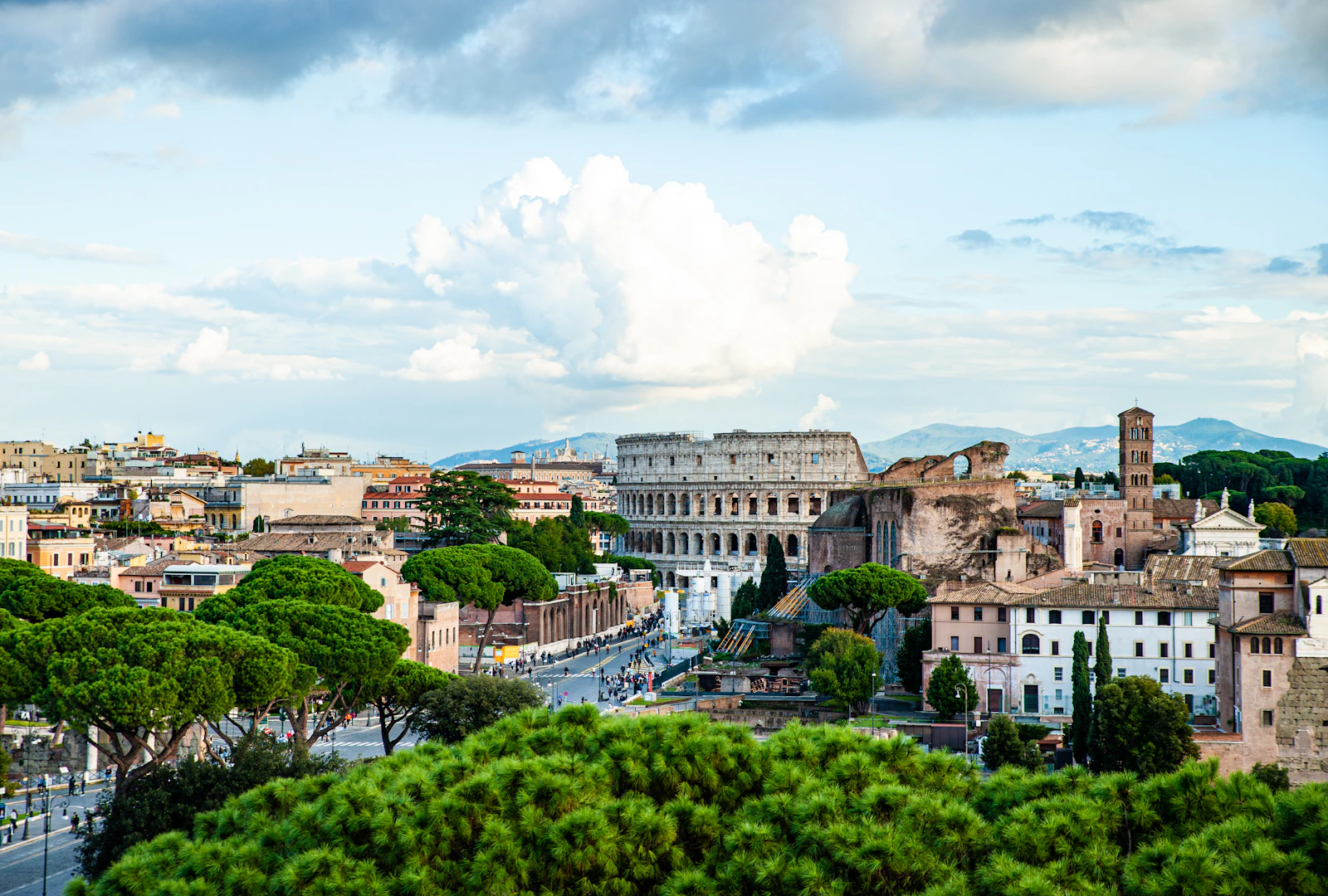
The largest amphitheatre ever built, the Colosseum was constructed between 72-80 AD under emperors Vespasian and Titus and held between 50,000-80,000 spectators for gladiatorial combat, public spectacles, animal hunts, and re-enacted naval battles—the entertainment industry of the ancient world operated at a scale of brutality and spectacle that still staggers modern visitors. The four-story elliptical structure of travertine limestone, tuff, and concrete, built using the forced labor of Jewish slaves following the destruction of Jerusalem, was partially dismantled over the centuries to build other Roman structures but remains one of the greatest architectural achievements of any civilization. Pre-booked timed entry tickets are essential to avoid multi-hour queues, and the underground Hypogeum tour revealing the network of tunnels where gladiators and animals waited before being raised by elevators into the arena is particularly gripping.
.jpg)
Triumphs were the ultimate honor for Roman generals, and this massive three-arched structure, erected in 315 AD, celebrates Constantine I’s victory at the Milvian Bridge. Interestingly, much of its decorative relief was 'recycled' from earlier monuments of Trajan, Hadrian, and Marcus Aurelius. Standing between the Colosseum and the Palatine Hill, it serves as a gateway to the ancient ceremonial heart of Rome. Expert recommendation: examine the different styles of carving to see the transition from classical to late-antique art. Pro tip: because it’s in a public open space, you can view it for free 24/7. It is beautifully lit at night, making it a great stop for late-evening strolls after the Colosseum crowds have left.

Once the beating heart of ancient Rome, the Forum served as the city's central hub for political, religious, and commercial life for centuries. Walking down the Via Sacra, you encounter the ruins of the Curia, the Temple of Saturn, and the Arch of Titus, evoking a sense of the immense power held by the Republic. The sensory experience is one of dusty majesty, where white marble fragments contrast against the deep green Mediterranean pines. Experts suggest starting at the Capitoline Hill overlook for a comprehensive layout view before descending. Pro tip: wear sturdy walking shoes as the ancient basalt stones are uneven; your Colosseum ticket includes entry here, so visit both on the same day.

The centermost of the Seven Hills of Rome, the Palatine is where the city was founded by Romulus according to legend. It became the exclusive domain of emperors, housing the sprawling ruins of the Domus Flavia and the Stadium of Domitian. The environment is lush with wildflowers and ancient pines, offering a more serene experience than the Forum below. Expert recommendation: visit the Palatine Museum to see artifacts found on-site and the House of Augustus for well-preserved frescoes. Pro tip: enter via the Via di San Gregorio entrance rather than the Colosseum side to drastically reduce your wait time for security checks.

Often described as the world's first shopping mall, this complex was built in the early 2nd century AD by Apollodorus of Damascus. The semi-circular brick structure housed offices and shops for the Roman Forum. Walking through the 'Via Biberatica,' the ancient street of taverns, you feel the density and sophistication of Roman urban life. Expert recommendation: visit the Museum of the Imperial Forums housed inside to see the architectural reconstructions. Pro tip: the upper levels offer an incredible, less-crowded vantage point looking down over the ruins of Trajan's Forum and the Victor Emmanuel monument. It’s an excellent alternative if the main Forum is too crowded.

San Clemente is an 'archaeological lasagna,' consisting of three layers: a 12th-century basilica built over a 4th-century church, which in turn was built over a 1st-century Roman house and a Mithraic temple. Descending into the damp, dark lower levels, you can hear the sound of an ancient underground stream still flowing through Roman pipes. Expert recommendation: the Mithraic altar, showing the god slaying a bull, is one of the best-preserved in the world. Pro tip: admission to the upper church is free, but the excavations require a ticket. It is just a 5-minute walk from the Colosseum and offers a much-needed cool environment on a hot summer day.
Perched on the top floor of the Palazzo Manfredi, Aroma offers what is arguably the most spectacular dining view in the world, directly overlooking the Colosseum. Chef Giuseppe Di Iorio serves sophisticated, Michelin-starred Mediterranean cuisine. The sensory experience is unparalleled as the ancient monument is lit up at night, seemingly within arm's reach of your table. Expert recommendation: the tasting menu provides a journey through refined Italian flavors, but the view is the true headliner. Pro tip: this is a prime spot for proposals and special occasions; book the 'front row' tables along the glass railing months in advance. Dress code is elegant; men should wear a jacket.