
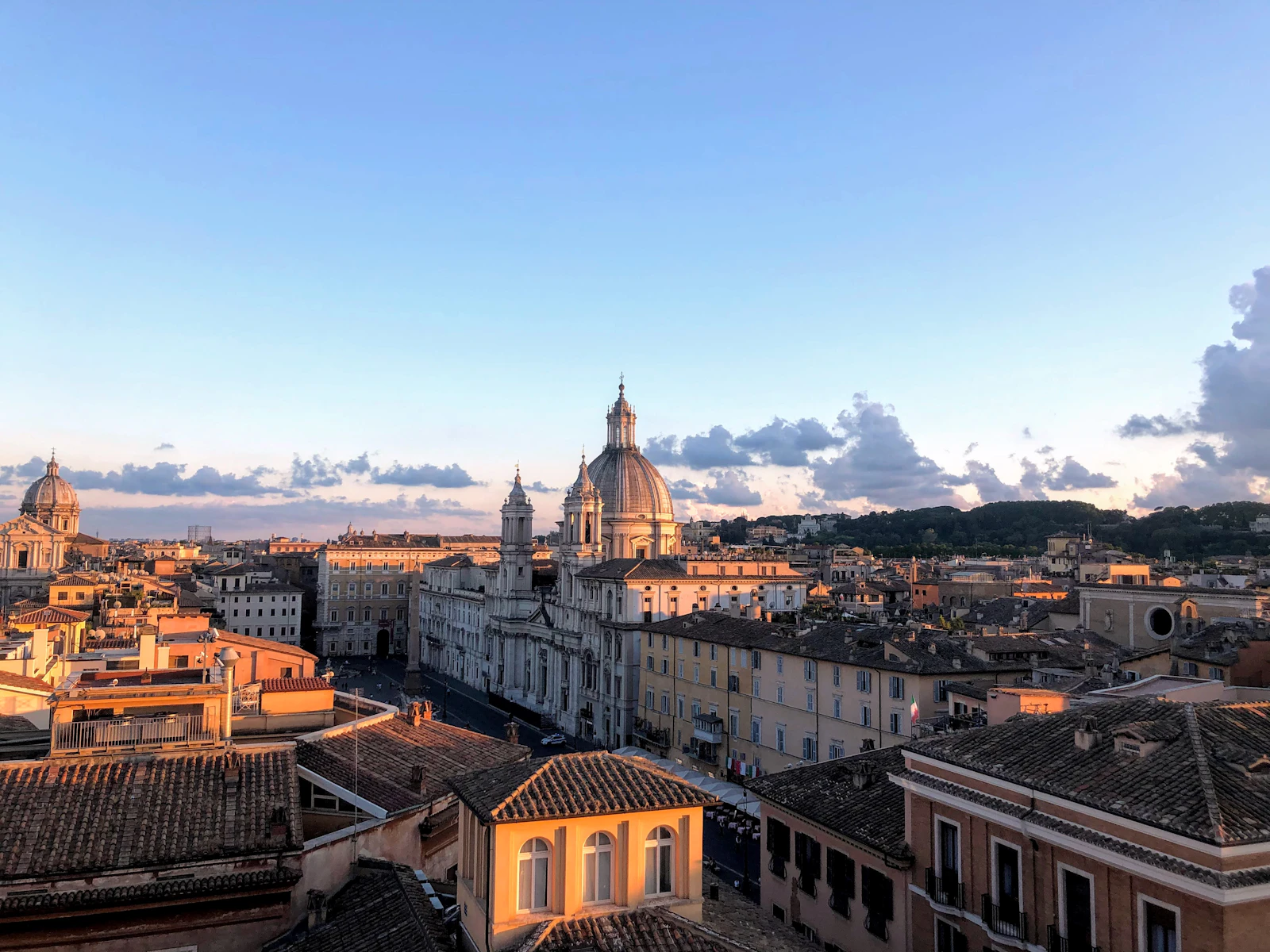
Rome 2-Day Ancient + Vatican
Rome 2-Day Ancient + Vatican
Rome was already a ruin when Michelangelo arrived. The city operates on a 2,000-year accumulation of debris — one civilization's rubble becomes the next one's foundation, which becomes the one after that's quarry material. The two-day version can't get to the Basilica di San Clemente, where three complete eras of Rome are stacked in one building, each using the previous one as a basement. But the principle applies everywhere.
The Vatican occupies the first full day: the museum complex in the morning before the tour buses fill it, St. Peter's afterward, the Ponte Sant'Angelo approach, and the Pantheon in the late afternoon while the oculus catches the correct light. The second day belongs to the ancient city: Colosseum at 08:30 before the queue forms, the Forum's ruined basilicas and vestal temples, Palatine Hill's imperial frescoes on the combined ticket, and the Capitoline Museums' Caravaggio and the she-wolf that started the whole story. Both days close at restaurants with the right relationship to their geography.
VoyRay Trip Planner
Make this itinerary your own
Start a new editable trip for Rome, then adjust the dates, route, places, budget, and travel pace to fit you.
Contents
Day 1
Day 1 — Vatican + Castel Sant'Angelo
The Vatican Museums are a three-hour problem with a Michelangelo payoff. The Sistine Chapel is the last room of 54 galleries, which is the correct approach: the ceiling lands harder after two miles of Raphael and Etruscan bronze. St. Peter's is free and physically unreal. The Pantheon is a 125 AD concrete dome — still the world's largest unreinforced structure — best seen around 16:30 when the oculus catches the afternoon light. Pierluigi for dinner near Campo de' Fiori.
The world's greatest collection of art accumulated over five centuries of papal patronage fills 54 galleries in the Vatican Palace, culminating in Michelangelo's Sistine Chapel ceiling painted between 1508-1512 while lying on scaffolding 20 meters above the floor—a physical and artistic feat that produced the most influential paintings in Western art history, including the iconic Creation of Adam. The Museum's Gallery of Maps with its stunning 16th-century cartographic frescoes, the Rafael Rooms with the School of Athens, the ancient Greek and Roman sculptures of the Laocoön group and the Apollo Belvedere, and the modern art collection added by recent popes create a day-long journey through the entirety of Western artistic tradition. Pre-booked tickets with early morning access significantly reduce the overwhelming crowds.

As the spiritual center of the Catholic world, this Renaissance masterpiece features contributions from Bramante, Michelangelo, and Bernini. Standing on the site of St. Peter's burial, the basilica's interior is overwhelmingly vast, housing Michelangelo’s poignant 'Pietà' and Bernini’s bronze Baldacchino. The sensory experience is profound, from the smell of incense to the golden light filtering through the dome. Expert recommendation: climb the 551 steps to the Cupola (dome) for the most iconic bird's-eye view of St. Peter's Square. Pro tip: strict dress codes apply (no bare shoulders or knees); arrive before 7:30 AM to clear security before the lines extend several hours long.
.jpg)
Originally built as a mausoleum for Emperor Hadrian, this cylindrical fortress later served as a papal residence and prison, connected to the Vatican by the Passetto di Borgo secret passage. The structure offers a layered history of Rome, from ancient tombs to Renaissance apartments decorated with lavish frescoes. The terrace under the bronze angel statue provides one of the city's best 360-degree views, especially overlooking the Tiber. Expert recommendation: look for the weapon collections and the historical prison cells. Pro tip: visit during the 'blue hour' just after sunset to see the bridge's angel statues glowing against the darkening sky; the rooftop cafe is surprisingly good for a scenic rest.

Originally built by Hadrian around 126 AD, the Pantheon is a marvel of ancient engineering, boasting the world's largest unreinforced concrete dome. Its transformation into a church in 609 AD ensured its preservation. The interior is defined by the dramatic oculus, a circular opening that invites a beam of sunlight—or rain—to dance across the polychrome marble floors. Cultural highlights include the tombs of Raphael and Italian kings. Best viewed during the 'Pentecost Rose Petal Drop' or exactly at noon for the light beam effect. Pro tip: as of 2023, a paid entry ticket is required; book your weekend slot online at least 48 hours in advance to bypass the massive lines winding around the piazza.
Established in 1938, Pierluigi is Rome’s premier seafood destination, located in a stunning, quiet piazza. It attracts a glamorous crowd of politicians, celebrities, and gourmands. The outdoor terrace offers one of the most elegant 'al fresco' dining experiences in the city, surrounded by Renaissance architecture. Expert recommendation: the raw seafood platter (crudo) is exceptionally fresh, and the 'Catalan-style Lobster' is a house specialty. Pro tip: this is a splurge-worthy venue with prices to match. Dress to impress, and be sure to book a table on the piazza well in advance for a summer evening dinner.
Day 2
Day 2 — Ancient Rome: Colosseum to Capitoline
The combined Colosseum-Forum-Palatine ticket covers three sites on one walk. The Forum's ground level is six meters below ancient street level; you're walking through the basement of the republic. Palatine Hill is where Augustus and his successors built their palaces — the views over the Forum were theirs. The Capitoline Museums close the afternoon with the original bronze Marcus Aurelius and the she-wolf; Felice a Testaccio closes the night.

The largest amphitheatre ever built, the Colosseum was constructed between 72-80 AD under emperors Vespasian and Titus and held between 50,000-80,000 spectators for gladiatorial combat, public spectacles, animal hunts, and re-enacted naval battles—the entertainment industry of the ancient world operated at a scale of brutality and spectacle that still staggers modern visitors. The four-story elliptical structure of travertine limestone, tuff, and concrete, built using the forced labor of Jewish slaves following the destruction of Jerusalem, was partially dismantled over the centuries to build other Roman structures but remains one of the greatest architectural achievements of any civilization. Pre-booked timed entry tickets are essential to avoid multi-hour queues, and the underground Hypogeum tour revealing the network of tunnels where gladiators and animals waited before being raised by elevators into the arena is particularly gripping.
.jpg)
Triumphs were the ultimate honor for Roman generals, and this massive three-arched structure, erected in 315 AD, celebrates Constantine I’s victory at the Milvian Bridge. Interestingly, much of its decorative relief was 'recycled' from earlier monuments of Trajan, Hadrian, and Marcus Aurelius. Standing between the Colosseum and the Palatine Hill, it serves as a gateway to the ancient ceremonial heart of Rome. Expert recommendation: examine the different styles of carving to see the transition from classical to late-antique art. Pro tip: because it’s in a public open space, you can view it for free 24/7. It is beautifully lit at night, making it a great stop for late-evening strolls after the Colosseum crowds have left.

Once the beating heart of ancient Rome, the Forum served as the city's central hub for political, religious, and commercial life for centuries. Walking down the Via Sacra, you encounter the ruins of the Curia, the Temple of Saturn, and the Arch of Titus, evoking a sense of the immense power held by the Republic. The sensory experience is one of dusty majesty, where white marble fragments contrast against the deep green Mediterranean pines. Experts suggest starting at the Capitoline Hill overlook for a comprehensive layout view before descending. Pro tip: wear sturdy walking shoes as the ancient basalt stones are uneven; your Colosseum ticket includes entry here, so visit both on the same day.

The centermost of the Seven Hills of Rome, the Palatine is where the city was founded by Romulus according to legend. It became the exclusive domain of emperors, housing the sprawling ruins of the Domus Flavia and the Stadium of Domitian. The environment is lush with wildflowers and ancient pines, offering a more serene experience than the Forum below. Expert recommendation: visit the Palatine Museum to see artifacts found on-site and the House of Augustus for well-preserved frescoes. Pro tip: enter via the Via di San Gregorio entrance rather than the Colosseum side to drastically reduce your wait time for security checks.
.jpg)
Dating back to 1471, these are considered the world's first public museums, located on the historic Capitoline Hill in buildings designed by Michelangelo. The collection is a treasure trove of Roman history, featuring the iconic 'Capitoline Wolf' and the massive bronze equestrian statue of Marcus Aurelius. The underground 'Galleria Lapidaria' connects the two main palaces and offers views over the Roman Forum. Expert recommendation: don't miss the Tabularium terrace for the most famous photo-op of the ruins below. Pro tip: the museum is often less crowded than the Vatican; spend time in the courtyard of the Palazzo dei Conservatori to see the giant fragments of the Colossus of Constantine.
Operating since 1936, Felice is a temple of Roman gastronomy in the historic working-class district of Testaccio. The restaurant is world-famous for its 'Cacio e Pepe,' which is ritually tossed by the waiter at your table to ensure the perfect emulsion of cheese and pasta water. The decor is a blend of traditional brick and modern polished design. Expert recommendation: the 'Cacio e Pepe' is mandatory, but their 'Stinco di Agnello' (lamb shank) is also exceptional. Pro tip: despite its size, it is perpetually booked out. You must reserve several weeks in advance. If you can't get a table, they recently opened a location in Milan, but the Testaccio original remains the definitive experience.