
Kyoto 3-Day Deep Dive
Kyoto 3-Day Deep Dive
Kyoto's quietest quality is how little it announces. The city is organized around a principle it never states: that the quality of a place in a specific hour is itself a form of design. Tenryu-ji's Sogenchi garden was laid out to be viewed from a specific bench at a specific elevation; Ryoan-ji's fifteen stones work differently in early morning than at noon. The craft of visiting Kyoto is learning to show up when the design becomes visible.
Three days gives each of the city's three geographic registers its own time. The western valley — Arashiyama's bamboo corridor, the Okochi Sanso villa above the bamboo line, the Togetsukyo bridge where the city releases its hold on the mountain — is a world self-contained. The northwest holds the most concentrated Zen compositions: Ryoan-ji's fifteen stones, Kinkaku-ji's gold pavilion, a soba lunch at Honke Owariya which has been at the same address since 1465. The eastern arc closes from Yasaka through Kiyomizu-dera and Sannenzaka down to Fushimi Inari, where the evening light on the gates carries a different quality from the afternoon.
VoyRay Trip Planner
Make this itinerary your own
Start a new editable trip for Kyoto, then adjust the dates, route, places, budget, and travel pace to fit you.
Contents
Day 1
Day 1 — Okochi Sanso Garden + Togetsukyo Bridge
Arashiyama holds its own season regardless of what month you arrive. Okochi Sanso's hilltop villa looks over the valley from above the bamboo line; the grove itself is most itself before 10am. The afternoon settles into the Sagano quarter — tofu lunch in the old restaurant district, then Tenryu-ji's Sogenchi garden, then the Togetsukyo bridge where the Hozu river marks where the city ends and the mountain begins.

This spectacular villa was the lifelong project of silent film star Denjiro Okochi, who spent 30 years perfecting its design. Nestled on the slopes of Mt. Ogura, the garden offers a sensory masterpiece of seasonal transitions and panoramic views of the Hozugawa River and Kyoto city. The experience is intimate and peaceful compared to the crowded bamboo grove nearby. Expert recommendation: Your entry fee includes high-quality matcha and a traditional sweet served in a teahouse overlooking the valley—do not skip this. Practical Pro Tip: The path involves some climbing, so wear sturdy shoes. It is one of the few places in Arashiyama where you can find true solitude and a deep connection to the 'Sukiya' architectural style.

Walking through the towering stalks of Sagano Bamboo Forest in Arashiyama is one of Japan's most ethereal experiences, as the dense groves of giant bamboo filter the sunlight into a diffuse green glow while the wind creates an eerie, otherworldly rustling that has been designated one of Japan's 100 Soundscapes to Preserve. The grove connects the Tenryu-ji UNESCO World Heritage garden to the Okochi Sanso villa, and the surrounding Arashiyama neighborhood offers rickshaw rides, monkey parks, cormorant fishing on the Oi River, and the stunning collection of Zen rock gardens at Jojakko-ji temple. Early morning visits before the tourist hordes arrive reveal the bamboo path in peaceful serenity.
Yudofu Sagano is a premier destination for boiled tofu (yudofu), a specialty of the Arashiyama area. Housed in a stunning Sukiya-style building with a lush Japanese garden, the restaurant offers a sensory experience of pure tranquility. The meal focuses on high-quality tofu simmered in a simple kombu broth, served with a variety of seasonal vegetarian sides. Historically, yudofu originated as a vegetarian staple for Zen monks. Expert recommendation: Order the full set menu to experience the different textures of tofu, from silken blocks to fried pieces. Pro tip: The best seats are in the traditional tatami rooms overlooking the garden. It is particularly magical during the autumn months when the maples outside turn bright red, providing a visual feast to accompany the delicate flavors of the meal.

Ranked number one among Kyoto's five great Zen temples, Tenryu-ji was founded in 1339 by Shogun Ashikaga Takauji to appease the spirit of a former emperor. The centerpiece is the Sogenchi Garden, which has survived in its original form for centuries and features a large pond surrounded by rocks and the pine-covered mountains of Arashiyama. The garden utilizes 'shakkei' (borrowed scenery) to integrate the distant landscape into its design. Inside the 'Hatto' hall, the 'Cloud Dragon' painting on the ceiling is a masterpiece of Zen art. The sensory experience is one of profound stillness, punctuated by the sound of water. Pro tip: Use the North Gate to exit directly into the Arashiyama Bamboo Grove. Try the temple’s acclaimed 'Shojin Ryori' (vegetarian monk's cuisine) at the on-site restaurant, Shigetsu, for a complete spiritual experience that engages all five senses.

The Togetsukyo, or 'Moon Crossing Bridge,' is the iconic symbol of Arashiyama. Originally built in the Heian Period (794-1185) and reconstructed in 1934, its wooden exterior masks a modern concrete core, blending traditional aesthetics with durability. The bridge spans the Oi River and offers a sensory feast of the surrounding forested mountains, which change color dramatically from the pink of spring cherry blossoms to the fiery reds of autumn. Culturally, it has been the subject of countless poems and woodblock prints. Expert recommendation: For the best view, walk along the riverbank towards the upstream side to see the bridge framed by the Arashiyama mountains. Pro tip: During the summer evenings (July-September), you can watch 'Ukai' (cormorant fishing), a traditional method using fire lanterns and trained birds. The bridge is also the starting point for the Sagano Scenic Railway.
Day 2
Day 2 — Ryoan-ji Temple + Kichi Kichi Omurice
The northwest temples require stillness to work. Ryoan-ji's fifteen-stone garden is a composition with no agreed solution, best seen early without rushing. Kinkaku-ji's gold pavilion is at its most precise on grey days when the reflection is clean. Honke Owariya has been serving soba at the same address since 1465. The day closes at Kichi Kichi, where one chef cooks omurice for eight at a counter — a performance that has become part of Kyoto's culinary mythology.

Ryoan-ji is home to the world's most famous Zen rock garden (kare-sansui). Constructed in the late 15th century, the rectangular plot of raked white gravel contains 15 mysterious stones arranged in five groups. Interestingly, from any vantage point on the veranda, at least one stone is always hidden from view—symbolizing that incomplete human perspective cannot see the whole truth. The simplicity of the design encourages deep introspection. Beyond the rock garden, the temple grounds feature a large pond with beautiful water lilies and a traditional 'tsukubai' water basin with a famous inscription about contentment. Arrive exactly at opening time (8:00 AM) to sit on the wooden veranda in silence before the crowds arrive. The temple is especially serene on rainy days when the wet stones glisten against the white gravel, highlighting the moss at their base.

The three-story Zen Buddhist temple pavilion whose top two floors are completely covered in gold leaf shimmers with breathtaking luminosity over the Mirror Pond, creating one of Japan's most iconic and frequently photographed images that has inspired artists and poets for six centuries. Originally built as a retirement villa for shogun Ashikaga Yoshimitsu in 1397 and converted into a temple after his death, the current structure is a 1955 reconstruction following an arsonist monk's fire that destroyed the original. The surrounding stroll garden with its carefully composed rockscapes, pine trees, and stone lanterns perfectly frames the golden pavilion from multiple viewpoints.
.jpg)
Established in 1465, Honke Owariya began as a confectionery shop and later became a purveyor of soba noodles to the Imperial Palace. It is one of the oldest operating restaurants in Japan. Housed in a charming traditional wooden building, the atmosphere is thick with history, featuring creaking stairs and low tables on tatami mats. The sensory highlight is the earthy aroma of buckwheat and the delicate, clean flavor of their dashi, made from pure Kyoto well water. Expert recommendation: Try the 'Hourai Soba,' a five-tiered dish served with various toppings like shrimp tempura, shiitake mushrooms, and wasabi. Pro tip: They still sell traditional 'Soba-machi' sweets at the front counter, which make for a great historic souvenir. Expect a wait during peak lunch hours, especially on weekends.
Kichi Kichi is a global culinary phenomenon led by the charismatic Chef Motokichi Yukimura. The restaurant specializes in 'Omurice'—a Japanese omelet over fried rice. The sensory experience here is pure performance art; the chef rhythmically narrates the cooking process, expertly slicing the fluffy omelet so it drapes perfectly over the rice before drizzling it with a rich demi-glace. The tiny, 8-seat counter creates an intimate, high-energy atmosphere. Expert recommendation: While the Omurice is the star, the beef stew and cream croquettes are also highly rated. Practical Pro Tip: Reservations are mandatory and notoriously difficult to secure; they open online exactly four weeks in advance at 11:00 AM JST and often sell out in seconds. If you cannot get a seat, the chef sometimes has a secondary takeaway window, but the full 'show' requires a counter booking.
Day 3
Day 3 — Okamen (Udon) + Fushimi Inari Taisha
The eastern corridor from Yasaka to Fushimi covers Kyoto's most intact historical streetscape in a single southward walk. Kiyomizu-dera occupies its wooden stage above the city as it has since 780. Sannenzaka is best walked slowly in the afternoon, when the ochaya tea houses open their sliding shutters. Fushimi Inari's lower torii catch the last light; the inner shrine is another hour's climb, worth it after most visitors have turned back.
Okamen is a beloved, old-school noodle shop located in the heart of Gion, serving the local community and geiko for decades. The atmosphere is quintessentially 'Showa-era,' with a simple, cozy interior and a quiet sense of tradition. They are famous for their 'Kyoto-style' udon, which features soft, thin noodles in a pale, elegant dashi broth made from high-quality kombu. The sensory experience is one of comforting warmth and subtle flavors. Expert recommendation: The 'Okame Udon,' topped with various ingredients arranged like a traditional theater mask, is their namesake and a must-try. Pro tip: This is a perfect, low-key spot for a quick and affordable lunch while exploring Gion. It is a hidden gem that remains authentic and largely unchanged by modern tourism trends.

Once known as Gion-sha, this shrine dates back over 1,350 years and is the spiritual heart of the Gion district. It is famous for hosting the Gion Matsuri, one of Japan's most prestigious festivals. The main hall combines the 'honden' and 'haiden' into a single building in a unique architectural style. At night, the shrine comes alive with hundreds of lanterns flickering on the central dance stage, each bearing the name of a local business donor. The 'Utsukushi Gozen-sha' sub-shrine is popular with those seeking beauty, featuring a small spring of 'beauty water' for the skin. Arrive in the evening when the vermilion gate is illuminated against the dark sky. It serves as the perfect gateway between the Gion district and Maruyama Park. The shrine is a center for New Year celebrations, where locals gather for the 'Okera Mairi' fire ritual.

Established in 778 AD, this iconic temple is best known for its massive wooden stage that juts out over the hillside, built without a single nail. It represents the 'Pure Water' sect and offers a spiritual connection to the Otowa Waterfall beneath the main hall. The sensory experience is dominated by the scent of incense and the sweeping views of Kyoto's skyline framed by cherry blossoms or maple trees. Pro tip: Drink from the three streams of the Otowa Waterfall to pray for longevity, success, or love, but choose only one to avoid being greedy. The temple is especially magical during special night illuminations in spring and autumn. Be prepared for a steep walk up the charming, pottery-lined Sannenzaka slope to reach the entrance, and look for the 'Zuigudo' hall for a unique 'womb crawling' meditative experience.

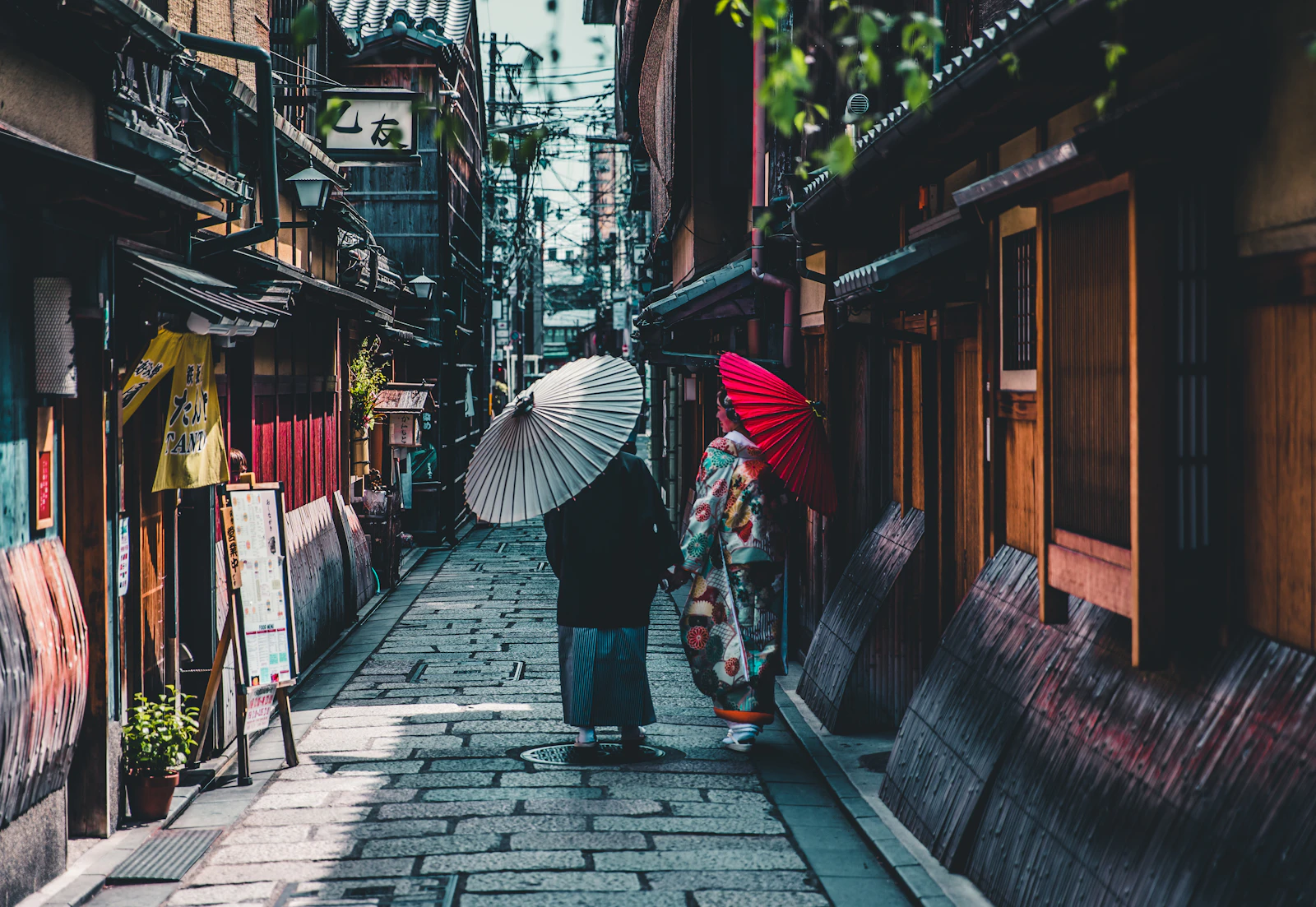
These two stone-paved pedestrian streets are among the most beautiful and preserved historic areas in Japan. Sloping down from Kiyomizu-dera, they are lined with traditional wooden buildings, ochaya (tea houses), and shops selling Kyoto specialties like 'Yatsuhashi' sweets and Kiyomizu-yaki pottery. The name Sannenzaka means 'Slope of Three Years,' and legend says if you fall here, you will have three years of bad luck—a story likely told to keep people careful on the steep steps. The sensory experience is like stepping back into the Edo period, especially when visitors in rented kimonos pass by. Expert recommendation: Look for the Starbucks housed in a 100-year-old traditional townhouse on Ninenzaka—it’s the first in the world with tatami seating. Pro tip: To photograph the streets without the crowds, arrive before 8:00 AM or after 8:00 PM when the shops close and the lanterns are lit.
Gion Tanto is a cozy, long-standing okonomiyaki and yakisoba specialist located right next to the scenic Shirakawa Canal. The restaurant is housed in a traditional wooden building and features a warm, steam-filled atmosphere where the sound of sizzling grills provides a constant soundtrack. Historically, it is a favorite local spot in Gion for a hearty, casual meal. The sensory experience is centered on the 'teppan' at each table, where thick, savory pancakes are finished with rich brown sauce and dancing bonito flakes. Expert recommendation: The seafood okonomiyaki is generously filled and highly recommended. Pro tip: Ask for a seat near the window for a view of the willow trees along the canal. It’s a very popular spot, so be prepared for a short wait during peak dinner hours.

The otherworldly tunnel of over 10,000 vermillion torii gates winding up Mount Inari for four kilometers is one of the most photographed and spiritually significant sights in all of Japan, dedicated to Inari, the Shinto god of rice, sake, and foxes. The full hike to the summit takes 2-3 hours and passes dozens of smaller shrines, stone fox guardians, and offering sites where businesses pray for prosperity, rewarding the effort with panoramic views of Kyoto from the upper trails. Dawn and dusk reveal the gates in their most magical light, and the upper paths remain uncrowded even when the lower sections teem with tourists.