
Taipei Travel Guide
Taipei is the rare East Asian capital that stayed messy in the good way. A Japanese-colonial post office next to a temple still burning incense. A 1913 Beitou bath-house up the line from Taipei 101. An oyster-omelette stall two MRT stops from a Michelin-starred dim sum room. The city never bulldozed its old layers to make room for the new ones — they all coexist on the same block. Mornings here are different from anywhere else. <strong>Taiwanese breakfast culture</strong> is a real thing: 05:30 to 11:00, hot soy milk, youtiao, fan tuan, served at counters that have been running for thirty years. By noon the breakfast spots are closing and the city pivots into lunch. By 17:00 it pivots again into the night markets — Shilin, Raohe, Ningxia — each with its own size and rhythm. By 22:00 the pepper-bun vendor at Raohe has just pulled the last batch of the night. This is the shortlist of places that survived a dozen repeat trips. The logistics layer covers what makes Taipei easy: the EasyCard, the three night-market rankings, the one day-trip train ticket that saves 45 minutes at Ruifang, and the breakfast hours you do not want to miss.
VoyRay Trip Planner
Turn this guide into a real trip
Start an editable trip for Taipei and use this guide as inspiration while choosing places and shaping each day.
12 places
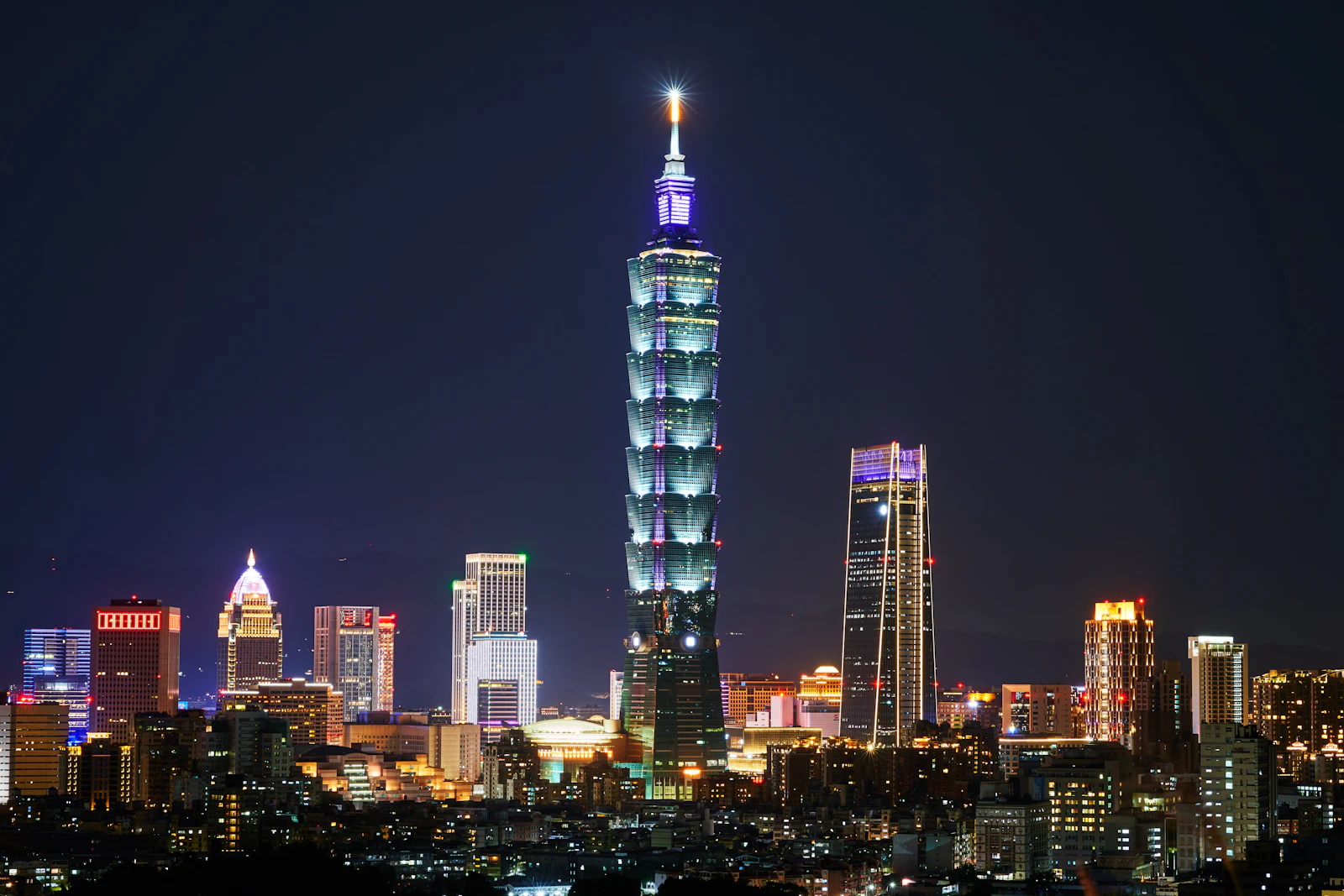
The 509.2m supertall tower in Xinyi — tallest in the world from 2004 until Burj Khalifa opened in 2010. **Observatory** on floor 89 (600 TWD, book online for skip-line) — the famous **730-ton golden damper** (a huge tuned mass damper that counters typhoon sway, visible on floor 88) is the engineering photograph. The express elevators run at 60.6 km/h (the world's fastest when installed). **Skip the retail floors 1-5** — they're a standard mall; the tower is the whole point. **Best views FROM** Taipei 101: Xiangshan hike (free, see below) or the 36F **Orchid** restaurant-bar. Open 09:00-22:00.

The 76m marble monument to the ROC's first president, completed 1980 — the staircase up (89 steps, for Chiang's 89 years) rises to a bronze statue reminiscent of the Lincoln Memorial, flanked by two white-gloved Honor Guards. **The hourly changing-of-the-guard ceremony** (09:00-17:00, on the hour, ~15 min) is the spectacle — drill movements rehearsed for months, zero wavering. Free entry. The gardens (Liberty Square) around the hall have the **National Theater** and **National Concert Hall** — the 1987 Chinese palace-style twins that are one of the city's best architectural photos. 45 min minimum.

The 1738 Buddhist-Taoist-syncretic temple in Wanhua — the most important actively-used temple in Taipei, rebuilt 5 times after typhoons, earthquakes, and WWII US bombs. Free entry. Go at **06:00 morning chanting** or **17:00-18:00 evening prayers** for the real thing — midday is tour-group-heavy. The **jiaobei moon blocks** (crescent divination pieces thrown on the floor to ask the gods yes/no questions) are what locals come for, especially at the Matsu altar. Buy incense from the outer gate (20 TWD). Don't step on thresholds; don't point at statues.

The world's most comprehensive Chinese imperial art collection — 700,000 pieces moved from Beijing's Forbidden City by Chiang Kai-shek's fleeing Nationalists in 1948-49. 350 TWD. Only 3,000 pieces on display at any time (rotating every 3 months). **The three 'signature' objects**: the Jadeite Cabbage (a single nephrite carving with preserved insects), the Meat-Shaped Stone (an agate marbled to look like braised pork), and the Mao Gong Ding (a 2,800-year-old Zhou dynasty bronze with a 497-character inscription). **Go Tuesday-Thursday**; weekends are overwhelming. Take the bus from Shilin MRT station; taxi is 200 TWD from Xinyi. Allow 3-4 hours.

The **free 20-minute hike** from Xiangshan MRT (red line terminal) that ends at the best possible view of Taipei 101 — the 'Six Giant Rocks' viewing platform puts you at 101's exact mid-height for the symmetric skyline shot. 600 steep steps (stone stairs, railings). **Best time**: 30-40 min before sunset, so you see Taipei daylit → sunset → dusk → 101 lit up, all in one visit. Bring a bottle of water. Free. The Monday/Friday evening traffic on the trail is heavy; weekends at sunset you queue 15 min for the photograph. Wear shoes not flip-flops.

The 1851 Qing-dynasty commercial street in Dadaocheng — **the only intact 19th-century trading quarter left in Taipei**, preserved as a conservation zone. Traditional Chinese pharmacies, tea merchants, textile shops, dried-seafood wholesalers — many operating continuously since the 1890s. **Go pre-Lunar-New-Year** (1 month before, usually January-February) to see the street at peak activity — the **Nianhua Dajie** New Year Market is the city's oldest festival tradition. **Sprout Café (ASW Tea House)** in a restored 1930s shophouse has upstairs seating — the tea ritual with the city view is worth the 300 TWD lunch set.
.jpg?width=1280)
Taipei's largest night market — 500+ stalls across the underground food court and the adjacent streets around the Cici Nigh Temple. **The priority stalls**: Hao Da Da-Ji-Pai (giant fried chicken, the 120 TWD paper-sized cutlet), Shilin Sausage-Wrapped Sausage (small sausage inside a large glutinous-rice sausage, 70 TWD), the oyster omelette stalls. **Open 16:00-01:00**; best after 20:00 when the full crowd energy hits. Jianshui is heavy — don't plan a big dinner before. **Walk the Alley Market (Yongjie Street)** south of the underground food court for less tourist-trappy street eats.

The 1913 Japanese-colonial bath-house in Beitou — Taipei's original public-bath infrastructure, converted to a museum in 1998. Free entry. **The half-sunken Roman-style octagonal main pool** (preserved as a museum piece, no longer operational) is the photographic centerpiece. The surrounding Beitou district has **10+ currently operating hot-spring hotels** — **Villa 32** (high-end, 2,500 TWD day pass) and **Longnaitang** (1907, the oldest public bath still running, 40 TWD entry) are the two ends of the spectrum. The underlying Beitou volcano water is sulfur-based — the smell is the point, not a flaw.

The 4km cable-car line from Taipei Zoo MRT station up into the Maokong tea-growing hills — 25 min, 120 TWD one-way, **book the 'Crystal Cabin'** (glass floor, additional 0 TWD) for the view down over Taipei. Maokong itself (the mountain top) is Taipei's main tea-tourism area — **Yao Yue Tea House**, **Big Teapot Tea Restaurant** are the classic options (200-400 TWD for pot + snacks). Open 09:00-21:00 Tue-Sun (closed Mondays for maintenance). **Go at 16:00** for daytime-to-sunset transition; the lights-of-Taipei night descent is the better version.

Taipei's mountain backyard — 114 km² of active volcanic terrain 30 min north of the city. Free entry. **Best access**: Bus 260 or 230 from Taipei Main Station (1 hour, 80 TWD). The two must-do hikes: **Xiaoyoukeng Recreation Area** (still-active sulfuric fumaroles, 40-min loop), and **Qingtiangang Grassland** (the cow-grazed alpine meadow, 30-min loop, Taipei's most unexpected landscape). **Cherry blossom season** late Feb-March (the 'Flowers Festival' — peaks on weekends, pack patience). The **Beitou Hot Springs + Yangmingshan combo** is one of Taipei's two signature day trips. Dress in layers; 10°C cooler than the city.

The 19th-century gold-mining mountain town 45 min east of Taipei — narrow stone-staircase streets lined with teahouses, the red-lantern-lit vista that directly inspired the 1997 Studio Ghibli film 'Spirited Away' (Miyazaki confirmed the connection). **A-Mei Tea House** is the one with the iconic lantern photograph. **Go weekday mornings** to avoid the weekend tourist-bus assault. **Access**: Keelung bus 788 from Songshan Station (1 hour, 50 TWD) or taxi (1,200-1,500 TWD from Taipei). **Combine with Shifen** (the other side of the mountain, lantern-release town) or **Houtong Cat Village** for a full day-trip.

The 1914 Japanese-era sake distillery converted in 2005 into Taipei's premier cultural campus — 7 hectares of brick-and-metal industrial buildings now holding rotating art exhibitions, design shops, indie cinema (**SPOT**), craft beer bars, and the **Eslite Spectrum** bookstore-café-maker space. Free to walk; exhibitions 100-350 TWD individually. **Go weekend afternoons** for the outdoor market vibe, or **Friday evenings** for the cinema-crowd density. The companion **Songshan Cultural and Creative Park** (1937 tobacco factory, Xinyi district) is the other half of the 'Taipei repurposed-industrial' story.
9 places
The original Din Tai Fung from 1972 — Yung-Kang Street branch is the 'real' original but Xinyi 101 is the current flagship for tourists. **Xiaolongbao** (6 TWD/piece, 200 TWD for 10) — the 18-fold dumpling standard is the export that made the chain world-famous. **Also order**: shrimp-and-pork shaomai, vegetable-and-pork dumplings, hot-and-sour soup. 200-350 TWD/head. **No reservations**; the Xinyi location often has 60-90 min waits at dinner. Arrive at 11:00 opening or 14:30-17:30 off-peak to avoid the queue. The **Yung-Kang Street original** is smaller, less touristy, same menu.
The 1963 Taiwanese-beef-noodle benchmark — Yong Kang Street 17, in the Daan beef-noodle street (4 competing shops in 100m). **Braised Beef Noodle with tendon** (230 TWD) is the dish — the broth is the 5-day-braised version, the tendon adds the textural element vs. just beef slices. Portion is hearty; share if eating 2-3 dishes. **Order also**: pickled cabbage (10 TWD, free refill), the ground-meat rice (80 TWD) as a side. **Always queue** 15-30 min; turn 3-4x per table. Open 11:00-21:00 daily. **Lin Dong Fang** (the other 1963 Taipei beef-noodle institution in Zhongshan) is the alternate argument.
The 1970s Taiwanese-breakfast institution on the 2F of Huashan Market (NOT the Huashan 1914 Creative Park — different Huashan). **Salty soy milk with youtiao** (40 TWD + 18 TWD for the stick) is the iconic breakfast — the savory soy milk is curdled with vinegar + soy sauce + chili oil + tiny dried shrimp, with a crispy fried-dough stick broken in. **The shaobing with egg** (60 TWD) is the other must-order. **Open 05:30-12:30**, typically sold out by 11:00. The line forms by 07:00 on weekends — 30-45 min wait. Cash only. The 2F location is deliberately inconvenient — don't mistake it for the street-level noodle shops.
The 600m night market near Songshan Station — more compact and walkable than Shilin, less tourist-trap. **The iconic must-order**: Fuzhou Black Pepper Bun (60 TWD, the stuffed-meat-bun the vendor slaps onto the inside of a charcoal tandoor oven — watch the flames at the entrance stall, Michelin Bib Gourmand since 2018). **Also**: the stinky tofu at stall 36, the oyster omelette stalls, the guabao (Taiwanese pork belly bun). **Open 17:00-23:30 daily**; peak 19:00-21:00. The **Ciyou Temple** at the entrance (1753) is the ritual photograph — red-pillared at night against the market crowd.

The Chef Richie Lin fine-dining pivot — contemporary Taiwanese-Nordic hybrid cuisine (Lin trained at Noma), ranked Asia's 50 Best top 10 since 2018. Dinner tasting 3,280 TWD (~$105), wine pairing 2,400 TWD. The philosophy: **Taiwanese produce rendered in Nordic plating/fermentation techniques** — mountain pear with fermented plum, 24-hour cured red grouper, banana-leaf smoked mountain pork. **Book 2-3 months ahead** at mume.tw. Closed Sundays. The wine list is Nordic-heavy; ask for the pairing. 3-hour dinner; start at 19:00.
André Chiang's post-Singapore Taiwanese fine-dining — 2 Michelin stars, ~$140 for the 10-course tasting menu. The kitchen's signature is the **seasonal Taiwanese-ingredient menu** refreshed 8 times a year around the farming calendar. 8-10 courses, 2.5 hours. Closed Mondays-Tuesdays. **Book 3 months ahead** (exactly 3 months to the day — the reservation system opens at 00:00 on the date). Large communal table + private rooms. The Zhongshan location is a 10-min cab from Xinyi. If RAW is booked, **Mume** is the alternate argument.
The 1975 Taiwanese-noodle institution in the Ximending alleyway — one dish, **Mian Xian** (a thickened soup with thin flour-rice noodles + braised pork intestine + oysters, 65-85 TWD). Standing-room only; no seats. The bowl is served in a small plastic cup — you eat it on the sidewalk with a porcelain spoon, walk a block, continue the Ximending exploration. Open 09:30-22:30 daily. The 'order at the counter, pay, sidestep to the serving hatch' system takes 90 seconds. Add chili oil + vinegar + cilantro at the condiment station.
The **converted seafood wholesale market** in Zhongshan — one building, 4 formats: (1) standing sushi counter (the Japanese-style quick-bite, 60-150 TWD/plate), (2) grilled seafood buffet (800-1,200 TWD), (3) Japanese BBQ shabu-shabu, (4) wine+oyster bar. The wholesale-market vibe (ice beds, shouting fishmongers, auction energy) is authentic — this IS a working wholesale operation 05:00-09:00, then pivots to retail-plus-restaurant 09:30-22:00. **Sit at the sushi counter** for the best Taipei sushi-for-the-price. No reservations for the counter; tables book via aad.com.tw.
The 1981 tea house in a converted Japanese-era 1920s house on Xinsheng South Road — **the Taipei intellectual-and-artist tea institution**. Hou Hsiao-hsien has filmed here; Li Ang wrote here. The ritual: order a pot (300-600 TWD depending on the leaf — oolong or pu'er are the house specialties), they serve 3+ hot-water refills, you settle in for 2-3 hours. The tatami rooms are sign-up-on-arrival. Closed Tuesdays. 1 hour from Yongkang Street beef noodle on foot; the post-lunch tea ritual is a Taipei afternoon.
6 places
The 303-room flagship on Dunhua North Road — 37 floors, the largest and arguably best-location luxury property in the city (between Xinyi and Zhongshan, adjacent to a metro interchange). Rates from 18,000-35,000 TWD/night. **The Mandarin Cake Shop** lobby café is the city's best afternoon tea. **Bencotto** (Italian) and **Ya Ge** (Cantonese) in-house are both serious restaurants. The pool + spa floor (20F) has Taipei 101 skyline view. The 'most-luxurious-sure-thing' Taipei hotel.

The 405-room W Hotels property in Xinyi — 31 floors, adjacent to Taipei 101 (literally, 2-block walk). Rates from 10,000-16,000 TWD/night. The **WOOBAR** lobby + **YEN Chinese restaurant** (dim sum brunch here is a Taipei ritual) are both destinations. The rooftop pool/lounge on floor 10 has 101 views. W's aesthetic (loud, design-forward, clubby) is very specific — it's the 'party Taipei' pick, not the traditional luxury one. The Xinyi location is walkable-to-everything for shopping and Xinyi nightlife.

The 208-room Japanese-managed property on Nanjing East Road — Hotel Okura Tokyo's Taipei flagship. Rates from 11,000-20,000 TWD/night. Japanese restraint in the interiors (blonde wood, tatami-inspired corridors, the restrained Okura aesthetic), Japanese-level service standards. **Yamazato** (kaiseki) and **Toh-Ka-Lin** (Cantonese) in-house. Location is Zhongshan-district — 10-min metro to Xinyi, 15 min to Xihmending. The 'Tokyo-service, Taipei-price' option — consistently one of the best-value serious-luxury rooms in the city.

The 42-room design boutique on Daan's Ren Ai Road — **Taipei's design-hotel benchmark**. Rates from 8,000-14,000 TWD/night. **The East End** (in-house restaurant, modern European-with-Asian-accents, strong sommelier) is one of the better sophisticated dinner options in Daan. The rooftop bar has good 101-adjacent skyline. Quiet-street location is deliberately un-Xinyi — more café culture + art scene. Breakfast served in-room is the signature. Adults-only. More specific than mass luxury.
The 129-room IHG Kimpton in Daan — 2019 opening, the first Kimpton in Greater China. Rates from 7,000-12,000 TWD/night. The locally-hyper-connected aesthetic (bamboo detailing, tile art, local tea service in-room) distinguishes it from chain luxury. **Tavernize** (in-house Italian) has a strong aperitivo hour 17:00-19:00 with free cicchetti for guests. Walkable to the Yongkang Street food corridor. The 'design-conscious mid-luxury' pick — 30% the price of Mandarin, 80% the experience for travelers who prefer boutique over grand-lobby.

The 5-villa super-luxury hot-spring ryokan in Beitou — **Taipei's only 5-star hot-spring resort**, with private sulfur-water bathhouses in each villa. Rates from 25,000-55,000 TWD/night (fully-included). The 2005 Japanese architect design (Kengo Kuma-inspired; actually designed by Yu Tzu-Yu) sits in a forested valley — truly isolated despite being 30 min from Taipei core. **Day passes** (2,500 TWD) include the public pool + 3-course lunch if you can't commit to the overnight. The fantasy-destination play — not a base for city sightseeing, a destination in itself.