
London Travel Guide
London expects you to have read the rules already. Stand on the right of the escalator. Order at the bar. Pack a waterproof. Mind the gap. Say thank you to the bus driver. None of these are politeness suggestions — they're the operating system, and locals will be quietly irritated if you don't have it installed. This is the shortlist across the city. The practical layer at the end is the part that catches first-timers: contactless tap-and-go, the pub-ordering protocol, the Tube etiquette, and the always-pack-a-jacket reality of English weather. Most of London is walkable, most of the rain is light, and most of the people are kinder than the reputation suggests — provided you've remembered the rules.
VoyRay Trip Planner
Turn this guide into a real trip
Start an editable trip for London and use this guide as inspiration while choosing places and shaping each day.
12 places
The 900-year-old Norman fortress on the north bank — William the Conqueror's original White Tower, the Crown Jewels in a 130-diamond display case, and 6 official ravens employed by the Crown (legend says the kingdom falls if they ever leave, so they're clipped-winged and fed ravens' meat daily). **Do the Yeoman Warder (Beefeater) tour** — it's free with your entry and the guides are all veterans with 22+ years of military service; the tour is genuinely hilarious and historically accurate in equal measure. Book online; arrive 09:00 for shortest Crown Jewels queue.

The world's original public museum (1753) — 8 million objects, 80,000 on display at any time. Priority route for 2-3 hours: Rosetta Stone (Room 4, Egyptian), Parthenon Marbles (Room 18, still officially called 'Elgin Marbles' in-museum), Assyrian lion hunt reliefs (Room 10), the Sutton Hoo helmet (Room 41, the Anglo-Saxon burial treasure). Free entry. The **Great Court** — Norman Foster's 2000 glass-roofed central courtyard, the largest covered square in Europe — is worth its own 10 minutes. Least crowded at 16:30 (museum closes 17:00, 20:30 on Fridays).
.JPG)
The coronation church since 1066 — where every English monarch except Edward V and Edward VIII has been crowned, where 17 monarchs are buried, and where Elizabeth II lay in state in 2022. **The Coronation Chair** (1308, the oldest piece of furniture in England still used for its original purpose) sits in the main nave. The Poets' Corner is where you can stand next to Chaucer, Dickens, Hardy, T.S. Eliot and more — and Darwin, Stephen Hawking, and Newton are also all buried here. Entry is ticketed (timed slots online). Closed Sundays except for services.

The monarch's official London residence since 1837 — 775 rooms, only the 19 State Rooms open to the public and only late July through September each year while the family is in Balmoral. **Changing of the Guard** happens at 11:00 on certain days (daily in summer, every other day in winter — check household.gov.uk for the current schedule, it's surprisingly inconsistent). Arrive by 10:30 for a workable view from the Queen Victoria Memorial. The state-rooms tour is actually excellent if you're here in summer; 35£, book in advance.

Christopher Wren's 1710 masterpiece, built after the Great Fire — the dome is still the second-largest church dome in the world after St. Peter's, and the London skyline's original anchor. **Climb the 528 steps to the Golden Gallery** (30-min climb, claustrophobic in sections) for the only unobstructed 360° view of central London; the Whispering Gallery on the way up lets you hear a whisper from 30m across. The crypt holds Wellington, Nelson, and Wren himself ('Si monumentum requiris, circumspice' — if you seek his monument, look around). 25£ entry. Closed Sundays.
_-_London,_ON.jpg)
The converted Bankside Power Station — Herzog & de Meuron's 2000 adaptation of Giles Gilbert Scott's 1947 turbine hall, now the world's most-visited contemporary art museum. Free entry to the permanent collection (Rothko Room, Picasso, Matisse, Warhol); paid exhibitions rotate. **The Turbine Hall** commissions are what bring people back — each year a different artist creates a massive-scale installation in the 155m-long former turbine chamber. 10th-floor viewing terrace has a free panorama of St. Paul's across the Millennium Bridge. Open late Fridays and Saturdays.

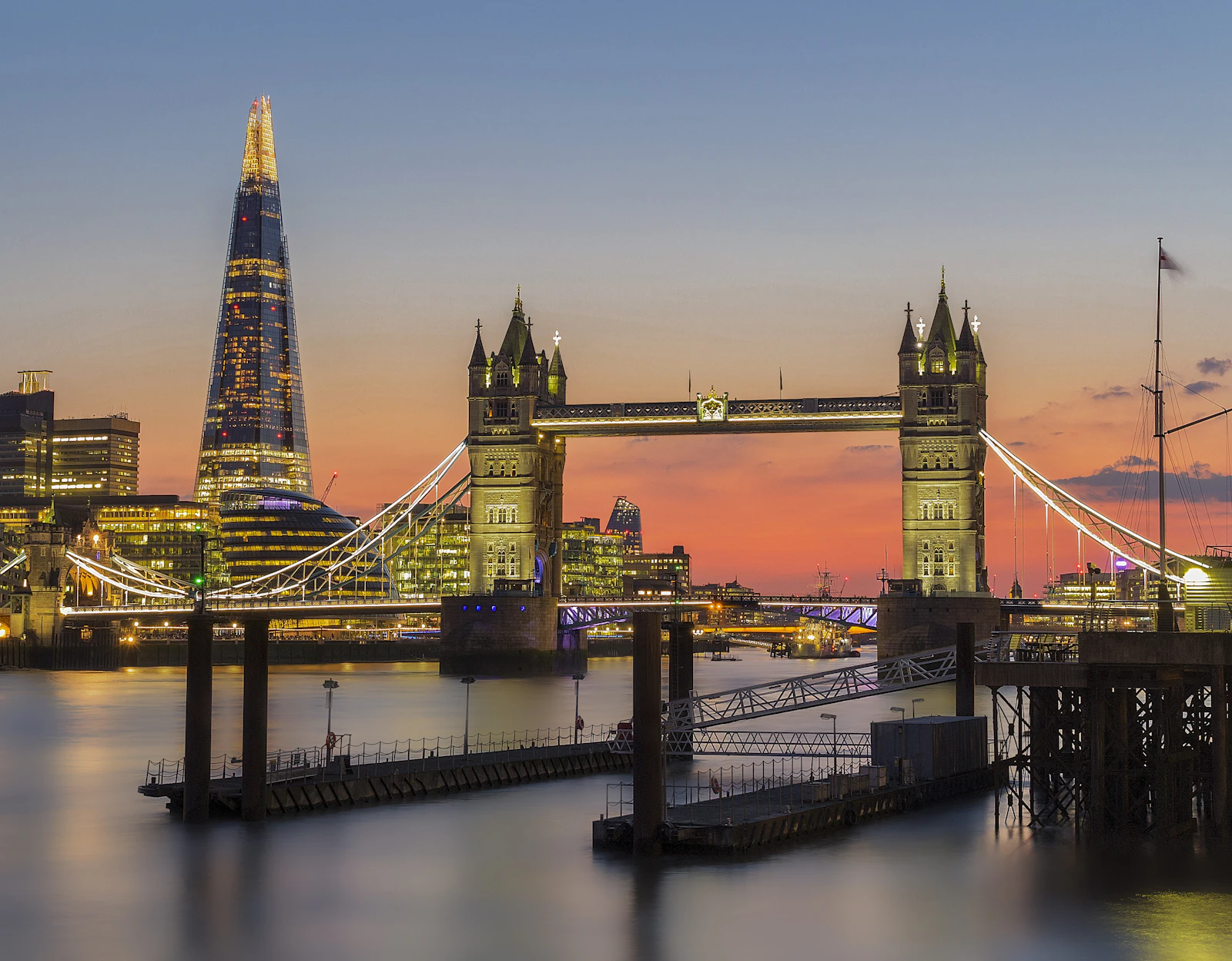
Not London Bridge — the one everyone thinks of when they say London Bridge is actually Tower Bridge, the 1894 Victorian-Gothic bascule bridge with the two turreted towers. It still opens mechanically 800+ times a year for tall ships (schedule posted online). **Pay the extra to go inside** the high-level walkways for the glass floor (panic-inducing, great photos) and the Victorian engine rooms in the south tower (gorgeous brass steampunk machinery). Walking across at sunset with the Shard to the south and the Tower of London to the west is the postcard London evening.

Trafalgar Square's north face — 2,300+ paintings from the 13th to 19th centuries, free entry. Priority for 2 hours: Room 30 (Van Gogh's Sunflowers), Room 34 (Turner's Fighting Temeraire), Room 57 (Velázquez's Rokeby Venus), the Sainsbury Wing for early Renaissance (Da Vinci's Virgin of the Rocks). The **Portrait Gallery** next door (National Portrait Gallery, reopened 2023 after a major refurbishment) is a separate excellent museum — a combination visit of both + the Trafalgar Square fountains + a Square Mile pub is one of London's best free afternoons.
_-_PPP743_-_Musée_des_Beaux-Arts_de_la_ville_de_Paris.jpg)
Properly the Elizabeth Tower (renamed 2012) — the 96m clock tower at the north end of the Palace of Westminster, completed in 1859. 'Big Ben' technically refers only to the 13.7-ton main bell inside, but nobody uses that distinction. **Interior tours** are available for UK residents only (British passport required). The exterior photograph is what tourists come for — best angle is from Westminster Bridge looking west; better still from the south bank across the Thames at golden hour with the bridge in the foreground. Big Ben chimes the hour 24/7 (you can hear it across most of Westminster).

The world's largest museum of decorative arts — 2.3 million objects across fashion, furniture, textiles, ceramics, sculpture, theatre, photography. Free entry. The **Cast Courts** (Rooms 46a and 46b) hold full-size plaster cast replicas of the world's greatest sculptures — Michelangelo's David, Trajan's Column, medieval church portals — a uniquely 19th-century concept still preserved intact. Current fashion exhibitions are routinely world-class. Café Poynter (in the original 1868 refreshment rooms — the world's first museum cafe) is an indoor attraction in its own right.

The 1997 reconstruction of the 1599 original (which burned down in 1613), built 230m from the original site using period-accurate oak, lime plaster, and Norfolk reed thatching — the only thatched roof allowed in London since the 1666 Great Fire. **See an actual play here if your dates allow** — the April–October season runs the authentic Elizabethan way (no artificial lighting, groundlings stand for 3 hours for 5£, weather in your face). Off-season guided tours (35 min, 25£) include the reconstructed playhouse interior and the adjacent Sam Wanamaker Playhouse (indoor candlelit theatre).

London's oldest food market — recorded in the 11th century, at its current site since the 13th. Covered wrought-iron structure from 1851. Open Tue-Sat with the full market on Thu-Sat. Priority stalls: **Neal's Yard Dairy** (British cheese — try the Montgomery Cheddar), **Brindisa** (Spanish chorizo roll, genuinely worth queueing), **Kappacasein** (raclette-on-potato at the south end, the most-queued item in the market for good reason), Monmouth Coffee nearby (not inside the market but the Bermondsey origin shop was Borough's coffee reference for decades). Lunch graze 40-60£/head easily.
.jpg)
6 places
The Irani cafe chain that essentially rewrote London's breakfast culture. Multiple locations (Covent Garden, Carnaby, Kensington, Shoreditch, King's Cross) but the cooking is consistent. **Must-order for breakfast**: the bacon naan roll (cream cheese, chilli jam, sriracha, bacon inside a hot naan — arguably the best breakfast sandwich in the UK), the big Bombay breakfast, masala beans on toast. For lunch/dinner: the famous black daal (slow-cooked 24 hours, the most-ordered dish chain-wide), Mahi tikka. Weekends: queue 45+ min; weekdays manageable. No reservations for under 6 people.

Fergus Henderson's 1994 restaurant that invented 'nose-to-tail' British cooking and influenced a generation of chefs globally. In a converted Georgian smokehouse on St. John Street next to the Smithfield meat market. Signature dishes: roast bone marrow with parsley salad (the single most-copied plated dish in modern British gastronomy), pig's head and radishes, Eccles cake with Lancashire cheese at the end. The natural-wine list is serious. **Lunch** is the move — same kitchen, 60-80£/head vs 100+ at dinner. Book 2-3 weeks ahead.

3 Michelin stars since 2021 — Clare Smyth is the first British woman to hold 3 stars in her own name. Located in Notting Hill, in a townhouse dining room that feels Victorian-domestic rather than luxury-hotel. Tasting menu is around 220£ for lunch, 290£ for dinner (7 courses). The signature 'potato and roe' — a slow-cooked charlotte potato with dulse beurre blanc and herring roe — is the dish. **Book 2 months ahead** via SevenRooms. Jacket not strictly required but most diners are in smart-casual+ territory.
The all-day European grand café on Piccadilly — in a 1921 former Wolseley Motors showroom, all marble and brass and theatrical coffered ceilings. Breakfast, lunch, afternoon tea, dinner — the menu covers Viennese schnitzel to eggs Benedict to English roasts. My go-to for breakfast: the full English breakfast (properly done — Cumberland sausage, streaky bacon, black pudding), or the kedgeree if it's on the specials. 20-35£/head for a proper meal. Reservations essential for dinner; breakfast walk-in usually fine at 09:00.

The 1945-throwback East End chippy — red-leather booths, retro signs, Elvis on the jukebox. Proper fish and chips done to the correct British protocol: beer-battered cod, hand-cut chips, mushy peas, white-bread tartar sauce, a dash of malt vinegar, a generous salt. 20£ for a plate of the haddock + chips + peas. The Spitalfields flagship is the original; Soho and Camden branches are newer. Open late (until 23:00), which makes it a proper after-theatre or after-market post-walk meal stop. **Takeaway is cheaper and equally good** — eat on the Brick Lane street wall.
.jpg)
The Mayfair afternoon-tea benchmark — in the 1856 Claridge's Hotel, designed Art Deco, still genuinely glamorous. 17 tea varieties sourced from Sri Lanka, China, Japan; finger sandwiches (the cucumber is the classic), fresh-baked scones with Cornish clotted cream and Marco Polo jam, patisserie including the famous lemon tart. 90-minute reservation slots, 80£/head for standard, 95£ with champagne. **Book 2-3 months ahead** — Claridge's tea is the single hardest London afternoon-tea reservation. Strict smart-elegant dress code: no sneakers, no ripped jeans, men in collared shirts. The experience is the event.
5 places
The Strand institution since 1889 — the hotel that introduced electric lighting to London, where Churchill and Chaplin drank in the bar, where Frank Sinatra recorded live in the ballroom. A massive 2010 restoration updated the rooms without gutting the character. Thames-view river rooms are the ones to book (the left bank of the hotel faces the Savoy courtyard and the right faces the river); the River Suites are worth the upgrade. American Bar is one of the world's 50 best bars, consistently. Afternoon tea at the Thames Foyer is the non-Claridge's alternative worth considering.

Mayfair's refined grown-up luxury option — in a 1897 red-brick Carlos Place mansion, quiet, residential, the kind of place ambassadors and quietly wealthy regulars stay. Service is genuinely old-school superb (the Connaught butler service for suite guests is a real thing). **Connaught Bar** (2021's world's #1 bar by voting) has the martini trolley and the most choreographed service in London. 2 Michelin-starred Hélène Darroze restaurant on premises. Rooms are 30-50m², generous for London luxury. If The Savoy is about theater, The Connaught is about refinement.
.jpg)
The 2017 Soho House Group opening — converted from the former Midland Bank HQ on Poultry, a 1924 Sir Edwin Lutyens building in the City. The main hall is 12m high with 92 green-marble columns; the 8 original bank restaurants on the ground floor have been converted into 8 separate hotel restaurants around a shared piano bar. Rooms are design-heavy; 320 rooms across 9 floors. **Ned's Club** rooftop pool (summer only) is members + hotel guests. A genuine design-hotel flagship in the City — location-wise it's ideal for Tower of London / Borough / Tate Modern mornings.
The mid-luxury design pick — the Holborn branch of the Hoxton chain in a 1925 Royal Mail building, on High Holborn between Covent Garden and Bloomsbury. Compact but thoughtful rooms (15-20m²), free phone with data included, 'Hoxton Breakfast' bag delivered at your door each morning. The Hubbard & Bell ground-floor restaurant is solid; Chicken Shop in the basement does one thing (rotisserie half-chicken, fries, slaw, 15£) perfectly. 200-350£/night depending on season — good value for the location.
The budget-smart design pick — the London Bankside citizenM is directly adjacent to Tate Modern and a 5-min walk to Borough Market and Shakespeare's Globe. Rooms are tiny but well-designed capsule style: king bed wall-to-wall, iPad controls for everything, huge rainshower in a glass cube. 150-250£/night depending on season. Lobby/bar/food is the best part — the 'citizenM Society' lounge has good co-working vibe, decent cocktails, 24-hour self-serve canteen. The perfect 'solo traveler in London on a budget but not an airbnb' choice.